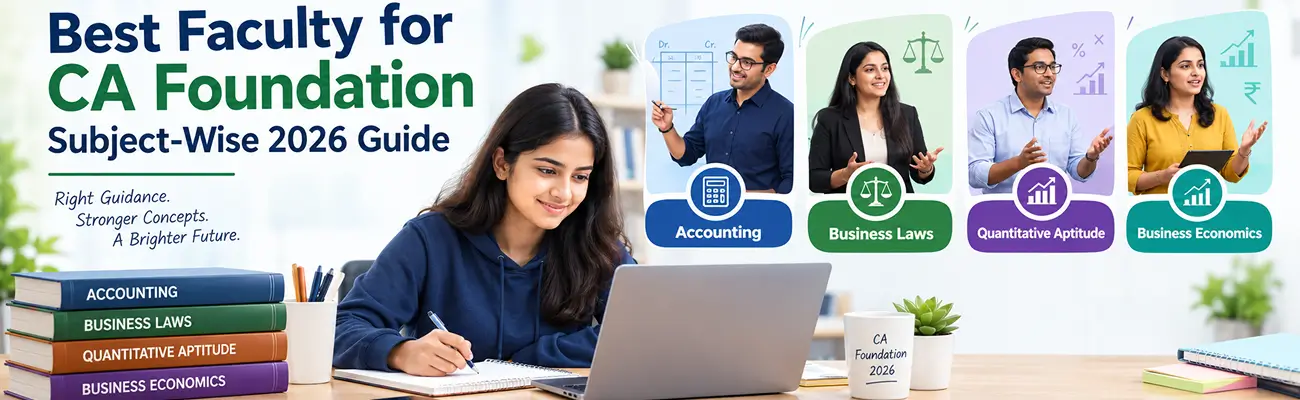
Best Faculty for CA Foundation: Subject-Wise 2026 Guide
Finding the best faculty for CA Foundation is typically the initial major decision that every aspiring CA has to make, even before he/she opens a textbook. The right teacher can make the difference between a smooth start to the first attempt and a stressful subsequent attempt between registration and the examination, with only a few months in between.
This guide brings together a subject-wise list of teachers commonly opted for by CA Foundation students for Accounting, Business Laws, Quantitative Aptitude, and Business Economics. The concept here is not to rank someone as "number one"; it's simply to find the best CA Foundation teacher for a specific paper, or to shortlist a complete CA Foundation online coaching batch for 2026. It's to help you explore your options and then choose what is appropriate for your learning style, because not all schools in the same faculty will be suitable for all students.
Best Faculty for Principles and Practice of Accounting.
Paper 1 (Accounting) is typically the first ‘real test’ to see how well the students are comfortable with numbers, journal entries, and financial statements, etc. Many students specifically look for the best teacher for CA Foundation Accounts before finalising a batch.
The most common faculties selected for this paper are:
- CA Parveen Sharma
- CA Hardik Manchanda
- Prof. Navneet Agarwal
- CA Anand Bhangariya
These faculties teach Accounting as per the ICAI Study Material and Practice Manual, with lectures available in live, recorded, and pen-drive/Google Drive formats.
Because Accounting relies heavily on practice, it's important to find out how much a faculty values the problem-solving group sessions, illustrations, and revisions of accounting standards before making a commitment to a batch.
Best Faculty For Business Laws
In paper 2 (Business law), the very common question is "Which faculty explains business laws in the simplest manner?” This paper is not just about company law, contract law, and business correspondence; it's also about interpretation, so it's not just about memorization. The faculties that are being opted for by the aspirants of CA Foundation are as follows:
- CA Darshan Khare
- CS Arjun Chhabra
- CS Pankaj Kumar
- Adv. Rishabh Gaur
All of them include the syllabus as prescribed by ICAI but vary in their approach in terms of presentation; some will include extensive notes on reading the Bare Act, and some will include section-wise analysis, while others will make use of case illustrations, charts, or memory aids to make the legal language more digestible. It is advisable to watch a demo lecture to understand which approach is better before taking admission to any best CA Foundation classes on this paper.
Best Faculty For Quantitative Aptitude (Maths, LR & Stats)
In Paper 3 (Quantitative Aptitude), students get three sections – Business Mathematics, Logical Reasoning and Statistics – in one paper, and it is usually the one section that is most difficult for students from non-math backgrounds. This is why it is one of the most searched questions by students is "who are the top faculties for CA Foundation maths?". Typical titles for this paper are:
- Prof. Kailash Thakur
- Mr. Omveer Singh
- CA Navneet Mundhra
- CA Pranav Popat
- CA Vinod Reddy
Faculties vary primarily in terms of how they develop speed and accuracy, be it by shortcut techniques, timed practice sets, or repeated concept drilling; this is a formula- and practice-driven paper. When selecting, it's beneficial to review the number of solved questions, practice, and doubt resolution that are included in the lecture.
Best faculty for Business Economics.
In Paper 4 (Business Economics), is a combination of theory and a little bit of applied logic in business, markets, demand-supply, and the business environment. When it comes to teaching this paper, often students ask which teacher makes it easier to teach economics than the rest and makes it easy to earn points. Usually selected faculties are:
- CA Hardik Manchanda
- CA Deepti Malik Sidana
- CA Akansha Arora
- Adv. Dipesh Sharma
The theory parts in Economics generally are about conceptual understanding and less about memorization, so students seek out faculties that provide examples of real businesses, diagrams, and short notes to demystify the theory before revision time.
Conclusion: How to Choose the Best Faculty for CA Foundation?
The answer as to who the best faculty for CA Foundation is is definitely not one size fits all; it is all about your personal learning style. Some pupils learn effectively from lengthy, detailed lectures that explain everything from the basics; others learn better from shorter lessons, with notes that are concise and to the point, with lots of practice questions. Ultimately, the best teacher is the one whose teaching style makes the subject “click” for you.
Before finalizing any CA Foundation coaching online batch, it helps to:
- Observe several demonstration lectures in various faculties for the same paper
- Read students' feedback and reviews who have taken the exam.
- Verify the similarity of the syllabus and study material being taught by the faculty with the ICAI syllabus and study material
- Ensure that the batch validity and format (live, recorded & offline) are compatible with your schedule
All the faculties above have been helping CA Foundation students nationwide in their learning, and most have updated their teaching material as per the changes in the exam pattern and the syllabus by ICAI. Don't rush in; take time before you sign up to explore — a good match in your first paper can make or break the rest of your CA career.
FAQs
1. Who is the best faculty for CA Foundation?
No one is the best CA Foundation faculty for every student. This pedagogy is going to rely upon your learning style, subject preference, speed, and need for practice and doubt support. You can find out by watching a demo lecture and reading the latest questions from students.
2. Which faculty is best for CA Foundation Accounts?
For CA Foundation Accounting, faculties like CA Parveen Sharma, CA Hardik Manchanda, Prof. Navneet Agarwal, and CA Anand Bhangariya are considered. To select, they should compare the way they teach, how they solve problems, how they revise the responses, and how well they match the ICAI syllabus.
3. Which is the best faculty for CA Foundation Maths?
The article mentions Prof. Kailash Thakur, Omveer Singh, CA, Pranav Popat, CA, and Vinod Reddy, CA as the faculties who are being considered by CA Foundation aspirants for Quantitative Aptitude. The student must select the course depending on the clarity of concept, practice questions, shortcuts, and doubt-solving.
4. How should I choose the best CA Foundation online coaching?
Firstly, watch demo lectures by various teachers, go through student reviews, and ensure that the course is based on the latest ICAI syllabus and study material, validity of batches, format of the lectures, revision support, and doubt-solving facilities.
5. Is online coaching good for CA Foundation preparation?
Yes, online coaching can be helpful for CA Foundation students as it provides flexibility in the form of live or recorded lectures, and students can also re-watch tough topics. But the learning mode doesn't matter as much as the quality of the faculty, consistency of self-study, practice, and revision.
About Author