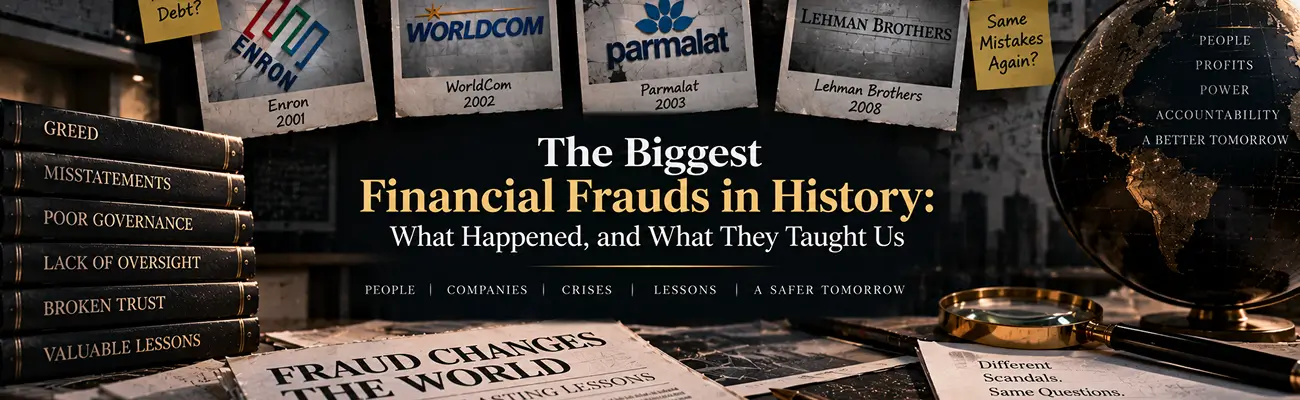
Biggest Financial Frauds in History: What Happened and What They Taught Us
Most of the biggest financial frauds in history follow the same basic script. A gap opens between what a company is actually earning and what it wants the world to believe it's earning, and someone finds a clever way to paper over it for a while.
Sometimes it's a reclassified expense. Sometimes it's a fake bank balance. Sometimes it's an "escrow account" that never actually holds a dollar. Whatever the method, the gap eventually becomes too wide to hide, and the aftermath tends to look eerily similar from one case to the next: wiped-out pensions, disgraced auditors, a fresh wave of regulation, and a story that ends up being taught in business schools for the next twenty years.
What Actually Counts as Financial Fraud?
Financial fraud means deliberately misrepresenting a company's finances or deceiving investors for gain, falsified statements, misleading disclosures, or Ponzi schemes where the "returns" are really just other investors' money getting recycled.
A company that fails because of bad decisions is not committing fraud. Neither is a company that pushes accounting rules right up to the legal edge without actually crossing it. Every entry in this list of famous financial fraud examples involves wrongdoing that a court, a regulator, or the person responsible has confirmed outright, which is exactly what separates a genuine scandal from a company that simply made a bad bet.
Top Corporate Fraud Case Studies
What follows is a rundown of the biggest financial frauds in history, told through some of the most talked-about names in the business world. Think of it as a set of real-life fraud case studies you can actually learn something from. Each one made it onto this biggest accounting scandals list because a court, regulator, or the person responsible confirmed the wrongdoing outright.
1. Enron Scandal
No rundown of the biggest financial frauds in history gets far without starting here.
By December 2001, Enron had gone from Wall Street's favorite stock to the largest corporate bankruptcy in American history up to that point. Executives had leaned on mark-to-market accounting and a tangle of off-balance-sheet partnerships to hide debt and smooth over lumpy, unstable earnings.
Once analysts and reporters started pulling the disclosures apart, the stock fell from around $90 a share to 26 cents in about a year. Roughly 25,000 employees lost their jobs, and many lost much of their retirement savings right along with them, since a large chunk of it had been sitting in Enron stock.
Even the company's auditor didn't make it out; Arthur Andersen was convicted of obstructing justice, a conviction the Supreme Court later overturned, though by then it didn't matter.
A firm that once employed about 28,000 people worldwide had already ceased to exist. Sarbanes-Oxley exists mainly because of this one collapse.
2. WorldCom
While Enron was still dominating headlines, WorldCom was quietly booking billions of dollars in ordinary operating costs, mostly line fees paid to other telecom carriers, as capital expenditures instead. That accounting sleight of hand let the company spread the costs out over years rather than take the hit all at once.
Internal auditor Cynthia Cooper and her small team uncovered the scheme in June 2002, working nights and weekends without even telling the CFO what they were doing. By the time it was sorted out, WorldCom had misstated its earnings by close to $11 billion, and investors lost more than $180 billion as the company's value collapsed. CEO Bernard Ebbers was sentenced to 25 years.
Among top corporate fraud case studies, this one is often cited as the reason internal audit needs a direct line to the board; Cooper's team only got anywhere because they worked around the very executives who might otherwise have buried what they found.
3. Bernie Madoff
If you're only going to remember one of these top corporate fraud case studies, it's probably this one. There wasn't much of a real business behind Madoff's fund, at least not the one his investors thought they'd bought into.
For roughly four decades, he ran a Ponzi scheme through his asset management arm, paying older investors with newer investors' cash and mailing out statements that showed smooth, steady gains no matter what the actual markets were doing.
It held together right up until the 2008 crash, when a wave of redemption requests outstripped the real money he had on hand. He pleaded guilty in 2009 to eleven felony counts, was sentenced to 150 years, and died in prison in April 2021. What happened afterward is almost as remarkable as the fraud itself. The Justice Department's Madoff Victim Fund made its tenth and final distribution in late 2024, bringing total payouts to about $4.3 billion across more than 40,000 victims in 127 countries, roughly 94% of documented losses. A separate court-supervised process run by trustee Irving Picard recovered close to $14.7 billion more, putting combined recoveries around $19 billion.
Few fraud victims ever get this much back, though it took more than fifteen years to happen. Steady returns that never dip, no matter what the market's doing, have been a red flag for a long time, and Madoff is the case everyone still points to.
4. Wirecard
Germany's Wirecard was a fintech darling and one of the few tech companies to earn a spot in the country's blue-chip DAX index. That lasted right up until June 2020, when the company admitted that around €1.9 billion, roughly a quarter of its balance sheet, probably didn't exist.
Prosecutors say executives had been fabricating transactions with third-party business partners for years to inflate revenue and assets. The whole thing started unraveling when auditor EY couldn't confirm that escrow accounts supposedly held in the Philippines were actually real, and the Philippine central bank backed that up.
Former CEO Markus Braun has been on trial in Munich since December 2022, and as of mid-2026 the proceedings had run more than 260 sessions over four years without a verdict, though a Munich appeals court ruling from January 2026 suggested judges see the fraud case against him as well-supported, with a sentence beyond ten years now a real possibility. Meanwhile, former COO Jan Marsalek fled to Russia before any of this became public and remains a fugitive to this day.
Even a company with Big Four auditors and a spot in a major stock index can hide a fraud this size when nobody actually checks whether the money is where it's supposed to be.
5. Satyam Computer Services
In January 2009, Satyam's founder and chairman, B. Ramalinga Raju, sent his own board a letter confessing to years of inflated cash balances and invented assets and revenue. People started calling it India's Enron almost immediately.
Damage estimates vary, but investigators put the losses around ₹14,000 crore. Raju and nine others were convicted in 2015 and got seven years each. Satyam's auditor had been with the company for a long stretch by then, which comes up often as an example of how auditor independence tends to erode the longer a relationship drags on.
6. Theranos
Among more recent famous financial fraud examples, few loom larger than this one. Elizabeth Holmes built Theranos into a company worth nearly $9 billion on the promise that a few drops of blood could run a full battery of diagnostic tests. It never actually worked that way. A 2015 Wall Street Journal investigation found the company was quietly running many of its tests on standard third-party lab equipment while telling investors and the public something else entirely.
Holmes was convicted of investor fraud and conspiracy in January 2022 and began serving an 11-plus-year sentence in 2023, later trimmed by about a year under revised federal sentencing guidelines. She and former COO Ramesh "Sunny" Balwani were jointly ordered to pay $452 million in restitution to twelve victims; Rupert Murdoch alone was owed $125 million of that, and the Ninth Circuit upheld the order in full in December 2025. The case gets brought up constantly now as an argument for separating founder charisma from actual technical due diligence, especially in healthcare, where getting the tech wrong isn't a minor inconvenience.
7. Parmalat
Europe's biggest bankruptcy at the time came out of, of all places, an Italian dairy company. Executives had invented a €3.95 billion Bank of America account that turned out to be completely fictional, just one piece of a much larger pattern of falsified statements and hidden offshore entities that added up to roughly €14.3 billion in disguised debt.
The whole thing collapsed in December 2003, the moment Bank of America told auditors the account simply didn't exist. Founder Calisto Tanzi turned 18 years old. Auditors still bring up Parmalat as the reason you verify account balances directly with the bank itself, not through whatever paperwork the client happens to hand you.
8. HealthSouth
The SEC accused the rehab-hospital chain in 2003 of inflating earnings by at least $1.4 billion, with later estimates running closer to $2.7 billion, largely so the company could keep hitting Wall Street's quarterly numbers right on the nose.
Fifteen executives eventually pleaded guilty, including every single person who'd served as CFO during the fraud. And yet founder and CEO Richard Scrushy was acquitted on every criminal count in 2005, even with his own former finance chiefs testifying against him. It's a reminder that plenty of fraud lower down a company doesn't necessarily guarantee a conviction at the top.
9. Volkswagen's Emissions Scandal
This one's a bit different; it's regulatory misconduct rather than financial-statement fraud, since nobody was cooking earnings reports. But it's big enough that it belongs on this list anyway. In September 2015, the EPA revealed that Volkswagen had rigged roughly 11 million diesel cars worldwide with software built specifically to detect an emissions test and cut emissions just long enough to pass it.
The company pleaded guilty to criminal charges in the U.S. and paid a $4.3 billion penalty there. Once fines, buybacks, and settlements around the world were all tallied up, the total ran north of €31 billion. Turns out lying to regulators can get just as expensive as lying to investors.
10. OneCoin
Not every entry among these real-life fraud case studies involves a household name; this one shows how far a good story can travel even without one.
Ruja Ignatova launched OneCoin in 2014 and marketed it hard as a cryptocurrency, borrowing all the usual language of blockchain and mining. Except there was no real, verifiable blockchain behind any of it; OneCoin's "value" was simply whatever the company decided it was, not something set by any actual market.
It spread through a multi-level-marketing referral network that prosecutors say defrauded investors of more than $4 billion. Ignatova vanished in October 2017, right before U.S. prosecutors unsealed an indictment against her, and she's still on the FBI's Ten Most Wanted list. The reward for information leading to her arrest now sits at up to $5 million, and as of mid-2026, she remains at large, though some reporting has floated the theory that she was killed by associates not long after she disappeared. Co-founder Karl Greenwood pleaded guilty and got 20 years.
An investment nobody outside the company can verify, and that can't be traded on any real market, is worth being suspicious of on its own, no matter how much crypto vocabulary gets attached to it.
Biggest Accounting Scandals List - Summary
| Case | Core Scheme | Approx. Losses | Key Outcome |
|---|---|---|---|
| Enron | Hid debt via off-balance-sheet partnerships | Largest US bankruptcy at the time | Sarbanes-Oxley Act passed; Arthur Andersen collapsed |
| WorldCom | Booked operating costs as capital expenditures | \~$11B misstated; $180B+ investor losses | CEO Bernard Ebbers, 25 years |
| Bernie Madoff | Decades-long Ponzi scheme | \~$19B recovered to date | 150-year sentence; died in prison (2021) |
| Wirecard | Fabricated transactions and fake escrow accounts | \~€1.9B missing | Trial ongoing; ex-COO still a fugitive |
| Satyam | Inflated cash, assets, and revenue | \~₹14,000 crore | Founder convicted, 7 years |
| Theranos | Fake blood-testing technology | $9B valuation wiped out | Elizabeth Holmes, 11+ years; $452M restitution |
| Parmalat | Invented a fictional €3.95B bank account | \~€14.3B disguised debt | Founder Calisto Tanzi, 18 years |
| HealthSouth | Inflated earnings to meet Wall Street targets | 1.4B–2.7B | 15 execs pled guilty; CEO acquitted |
| Volkswagen | Emissions-test-cheating software ("Dieselgate") | €31B+ in fines/settlements | $4.3B US penalty; guilty plea |
| OneCoin | Fake cryptocurrency, MLM structure | $4B+ | Co-founder got 20 years; founder still at large |
What These Scandals All Had in Common
Enron, WorldCom, Wirecard, Satyam, Parmalat, and HealthSouth belong on the same list for a simple reason: each one involved numbers that were made up outright, not just an aggressive reading of accounting rules that stayed technically within the lines.
Investors, lenders, and employees build real decisions on top of financial statements. When those statements turn out to be fiction, the damage rarely leaks out slowly; it tends to hit all at once, right around the moment the fraud has finally gotten too big to keep hidden. Look closely, and you'll find the same handful of warning signs behind nearly every one of the biggest financial frauds in history.
The Warning Signs That Keep Showing Up
A handful of patterns show up again and again across these real-life fraud case studies: weak internal controls, boards too deferential to push back on a strong founder or CEO, and auditors who've grown too close to the client over too many years.
Add to that earnings numbers that line up suspiciously well with analyst expectations quarter after quarter, and warnings from whistleblowers, reporters, or short-sellers that got waved off for far longer than they should have been. Throw in regulatory gaps around new asset classes and cross-border operations, and you get exactly the kind of environment where something like Wirecard or OneCoin can keep running for years before anyone with real authority steps in.
Lessons from Corporate Scandals
Unusually smooth returns and vague explanations deserve more scrutiny, not less. Madoff is the extreme version of that lesson, but the same instinct holds up in far smaller cases too.
Real independence from management, paired with a whistleblower channel people actually trust, tends to be what separates catching fraud early from reading about it after the fact. Auditors verifying balances directly with banks and custodians, instead of leaning on whatever paperwork the client hands over, sounds like an obvious step, yet Parmalat and Wirecard both show how often it still gets skipped. Better coordination across borders would go a long way toward closing the gaps that let cases like OneCoin and Wirecard run as long as they did.
FAQs
1. What is the biggest financial fraud in history?
Depends how you count it. Madoff's Ponzi scheme moved the most money over the longest stretch. Enron and WorldCom did more damage to the market and to how companies get regulated.
2. What is the difference between fraud and a bad business decision?
Intent. A company that makes a wrong bet isn't committing fraud. Someone deliberately faking the numbers is, that's the line regulators and courts draw every time.
3. Why do auditors fail to catch corporate fraud?
Because these schemes are built to survive an audit, not just fool the public. Unverified confirmation letters, escrow accounts nobody actually called the bank about, auditor relationships that got too comfortable over too many years. The fraud isn't smarter than the audit, it's just aimed at exactly where the audit doesn't look.
4. What causes a corporate fraud scandal to collapse?
Running out of cash, not getting caught. Parmalat couldn't cover a shortfall it was counting on. Madoff couldn't handle a wave of redemptions after 2008. The lie holds until the money actually has to show up somewhere.
5. Are corporate fraud scandals still happening today?
Yes, Wirecard's still in court, Ignatova's still missing, and OneCoin proved the same playbook works fine in crypto too. The tools change. The pattern doesn't.
Conclusion
Work through enough real-life fraud case studies and one thing keeps repeating: concentrated control with weak oversight around it is still where the next big fraud is most likely to grow. That's the throughline connecting every name on this list, and it's why the biggest financial frauds in history keep getting studied, referenced, and taught decades after the headlines fade, the mechanics change, but the underlying lessons from corporate scandals rarely do.
About Author