- What Is ICAI Peer Review?
- Who Needs to Apply for ICAI Peer Review?
- ICAI Peer Review Requirements: What to Prepare Before Applying?
- How to Apply for Peer Review ICAI Online: Step-by-Step Process
- What Is ICAI Peer Review Form 1?
- What Happens After Submitting Peer Review Form 1?
- ICAI Peer Review Fees and Processing Timeline
- Important ICAI Peer Review Forms and Official Resources
- FAQs
- Conclusion
↓
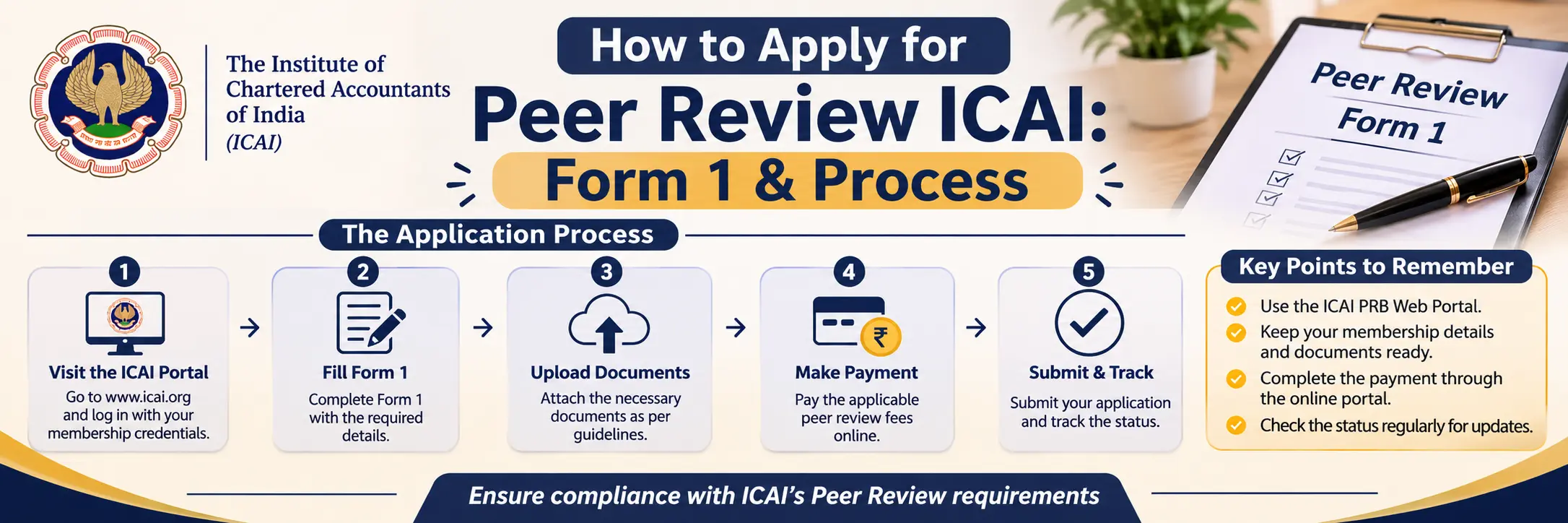
How to Apply for Peer Review ICAI: Form 1, Eligibility & Online Process
CA Archit Agarwal |
Thu, November 12, 2026
If you are wondering how to apply for peer review at ICAI, the first step is to understand your practice unit's eligibility and prepare the information required for Form 1. The Institute of Chartered Accountants of India (ICAI) has made the Peer Review Board's online portal available for Practice Units to initiate the application process.
The application begins with Form 1 – Application cum Questionnaire, which collects information about the firm's constitution, partners, branches, assurance engagements, and quality control procedures. The questionnaire also includes Part C relating to the Audit Quality Maturity Model (AQMM) V2.0, wherever applicable.
In this guide, we explain the ICAI peer review requirements, how to complete Form 1, the online application process, the information you should keep ready, and what happens after submission.
What Is ICAI Peer Review?
ICAI Peer Review is a quality assurance mechanism through which the professional work and systems of a chartered accountant's practice unit are examined by an independent peer reviewer.
The main objective is to check whether the practice unit:
- Complies with applicable technical, professional, and ethical standards.
- Maintains appropriate systems and procedures for conducting assurance engagements.
- Follows suitable quality control practices.
- Maintains proper documentation to demonstrate the quality of its professional work.
The Peer Review Board (PRB), which is established by ICAI, oversees the process, appoints peer reviewers, and considers their reports before deciding on the issuance of a Peer Review Certificate.
Peer review is governed by the Peer Review Guidelines, 2022, which came into effect on 1 October 2022.
You can read the official ICAI Peer Review Guidelines, 2022, through the PRB portal.
1. Why Is Peer Review Required?
Peer review helps improve the quality and consistency of assurance services provided by chartered accountants.
It encourages CA firms to maintain proper documentation, follow professional standards, and establish suitable quality management procedures.
It also helps identify gaps in a firm's existing practices so that corrective measures can be taken.
Also read: ICAI Campus Placements - Complete Preparation Guide
2. Peer Review vs Statutory Audit
Although both involve examining professional work, statutory audits and peer reviews serve different purposes.
| Basis | Statutory Audit | Peer Review |
|---|---|---|
| Main purpose | Examine a client's financial statements | Evaluate the quality of a practice unit's assurance work and systems |
| Subject | Client's financial statements and records | Practice unit's professional work and quality controls |
| Conducted by | Statutory auditor | Independent peer reviewer appointed through the PRB process |
| Focus | Whether financial statements present a true and fair view | Compliance with applicable professional standards and quality procedures |
| Outcome | Audit report | Peer Review Report and, subject to Board approval, Peer Review Certificate |
For a better understanding of the statutory audit process, read our guide on Company Audit: Process, Types, and Importance.
Who Needs to Apply for ICAI Peer Review?
ICAI Peer Review requirements apply to practice units falling under the categories specified in the Peer Review Guidelines and the Peer Review Mandate.
The mandate was introduced in phases to extend peer review coverage to different categories of practice units.
The applicability of the phases has been revised through subsequent ICAI announcements. Therefore, firms should refer to the latest announcement instead of relying only on the original implementation dates.
1. Mandatory Peer Review Categories
The four phases of the mandate cover the following categories:
| Phase | Practice Units Covered | Current Implementation Date |
|---|---|---|
| Phase I | Practice Units proposing to undertake statutory audits of enterprises whose equity or debt securities are listed in India or abroad | 1 April 2022 |
| Phase II | Practice Units proposing to audit specified large unlisted public companies, or Practice Units rendering attestation services with five or more partners | 1 April 2024 |
| Phase III | Practice Units proposing to audit specified entities that raised funds exceeding ₹50 crore, or Practice Units rendering attestation services with four or more partners | 1 July 2025 |
| Phase IV | Practice Units proposing to audit branches of public sector banks, or Practice Units rendering attestation services with three or more partners | 31 December 2026 |
Important: ICAI announced on 31 December 2025 that Phase IV, which was earlier scheduled to become applicable from 1 January 2026, was extended to 31 December 2026. The Phase III implementation date was also revised to 1 July 2025 through the announcement dated 22 January 2025.
Firms should check the applicable conditions, including the nature of assurance services and the relevant partner count, before deciding whether they fall under a mandatory category.
Refer to the ICAI Peer Review Mandate and the latest announcements for the applicable conditions and amendments.
2. Can a CA Firm Apply for Voluntary Peer Review?
Yes. A practice unit can apply for peer review voluntarily, even if it is not covered under the mandatory categories, subject to the applicable provisions of the Peer Review Guidelines.
Voluntary peer review can help a firm assess its quality control procedures and identify areas that need improvement.
3. What About Newly Established CA Firms?
ICAI also recognises a separate category called a New Unit under the Peer Review Guidelines.
A practice unit established for less than 12 months immediately before the receipt of its application may apply under the New Unit category, subject to the additional conditions prescribed by the Board.
New Units should not automatically select the voluntary category. They should check the specific eligibility conditions applicable to them.
ICAI Peer Review Requirements: What to Prepare Before Applying?
Before starting the ICAI peer review application, organise the firm's information for the review period. This will make it easier to complete Form 1 and reduce the chances of inconsistencies.
The following checklist covers the main information requested in the Form 1 questionnaire.
1. Practice Unit Details
Before applying, you must keep the following information ready:
- Name of the Practice Unit as per ICAI records.
- Firm Registration Number (FRN), or Membership Number in the case of an individual practitioner.
- Constitution of the Practice Unit.
- Date of establishment.
- Head office and branch details.
- Registered address, email ID and website, where applicable.
- Details of any professional network membership.
The information should match the relevant ICAI records and firm particulars.
2. Partner and Employee Details
Prepare details of the partners and professional staff associated with the practice unit during the review period. This may include:
- Names and Membership Numbers of partners.
- Dates or years of joining and leaving.
- Professional experience and qualifications.
- Chartered accountants employed or working as paid assistants.
- Details of other employees and administrative staff.
- Branch-wise staff and member-in-charge information.
Make sure changes in the firm's constitution are properly reflected.
3. Gross Receipts and Financial Information
Form 1 asks for the gross receipts of the Practice Unit as per its books of accounts.
Prepare the relevant financial-year-wise figures for the review period. The questionnaire seeks information about receipts from assurance functions and, where required, the overall gross receipts of the Practice Unit.
Keep the figures organised separately for the head office and branches, wherever applicable.
4. Assurance Engagement Details
Prepare a list of assurance engagements for which reports or certificates were signed during the review period. The information may include:
- Client name or identification code.
- Client category.
- Type of assurance engagement.
- Financial year.
- Branch or head office handling the assignment.
- Signing partner.
- Relevant financial information requested in the questionnaire.
- Whether an engagement quality review was conducted, where applicable.
The engagement list should be complete and consistent with the practice unit's records.
5. Quality Control Policies and Procedures
The questionnaire also examines the firm's quality control arrangements. Prepare information about the policies and procedures followed for:
- Leadership responsibilities for quality.
- Compliance with ethical requirements.
- Client acceptance and continuance.
- Human resource management.
- Engagement performance.
- Monitoring and review of professional work.
Keep relevant documentation available to explain how these procedures operate in practice.
6. AQMM V2.0 Information
Part C of Form 1 relates to the Audit Quality Maturity Model (AQMM).
ICAI's applicable forms page provides Part C under AQMM V2.0 for peer reviews initiated on or after 1 April 2025.
Practice Units should refer to the applicable AQMM V2.0 questionnaire and implementation guidance before completing this section.
Official resources:
How to Apply for Peer Review ICAI Online: Step-by-Step Process
Practice units can initiate the peer review process through the official Peer Review Board portal.
Official portal: https://prb.icai.org/
ICAI also provides a video manual titled How to Fill Form 1 on the portal. Use the current portal instructions when completing the application, as the interface and filing procedure may be updated.
Step 1: Check Your Peer Review Category
Before opening Form 1, determine why your practice unit is applying. The available categories under the prescribed application include:
- Mandatory peer review.
- Voluntary peer review.
- Special-case review initiated by the Board.
- New Unit.
- Application as per the Board's decision.
Select the category that correctly applies to your practice unit. If you are applying under the mandatory category, check the relevant phase and conditions.
Step 2: Visit the Official PRB Portal
Open the ICAI Peer Review Board portal. The portal provides access to practice unit and peer reviewer login options, applicable forms, guidelines, manuals, and other peer review resources.
Use the official portal rather than relying on third-party application links.
Step 3: Log In as a Practice Unit
Select the Practice Unit login option and follow the portal's current authentication instructions.
Use the membership and firm details associated with the Practice Unit. Ensure that the person handling the application is authorised to provide and submit the firm's information.
If you manage more than one practice unit, verify that you are working on the correct firm's application.
Step 4: Start the Form 1 Application
Select the option to initiate a peer review application. Form 1 is the prescribed application cum questionnaire under Clause 6 of the Peer Review Guidelines, 2022.
The application section asks for details such as:
- Name of the Practice Unit.
- Firm Registration Number or Membership Number.
- Review period.
- Applicable reason or category for applying.
- Type of assurance services provided.
- Relevant declarations.
- Communication and contact details.
The Practice Unit should ensure that its name and registration details match ICAI records.
Step 5: Complete Part A – Profile of the Practice Unit
Part A of the questionnaire collects information about the Practice Unit. You need to provide details relating to:
- Firm constitution and establishment.
- Head office and branches.
- Partners and their association with the firm.
- Chartered accountants employed.
- Other employees and paid assistants.
- Professional network membership.
- Gross receipts.
- Client concentration.
- Previous peer review details, where applicable.
Make sure the information relates to the review period specified in the application.
Step 6: Add Assurance Engagement Information
Enter the details of assurance engagements undertaken by the Practice Unit during the review period. The questionnaire includes categories such as:
- Central statutory audit.
- Statutory audit.
- Tax audit.
- Internal audit.
- Concurrent audit.
- Certification work.
- Other applicable assurance engagements.
Provide the requested client, branch, signing partner, and engagement details. Do not omit assignments simply because they were handled by a branch or a different partner.
Step 7: Complete Part B – Quality Control Questionnaire
Part B focuses on the firm's quality control systems and procedures. It covers areas such as leadership responsibility, ethical requirements, client acceptance and continuance, human resources, engagement performance, and monitoring.
Answer the questions based on the policies and procedures actually followed by the firm. Where the questionnaire asks for supporting information, ensure that the firm can provide appropriate documentation.
Step 8: Complete Part C – AQMM V2.0, Where Applicable
Part C relates to the Audit Quality Maturity Model. For peer reviews initiated on or after 1 April 2025, ICAI's applicable forms page provides Part C under AQMM V2.0.
Refer to the official questionnaire and implementation guide while completing the applicable assessment. Do not assume that the older AQMM V1.0 guidance in earlier publications is the current version for these applications.
Step 9: Review and Submit Form 1
Before submitting, verify the details entered in the application. Pay particular attention to the following:
- Firm and branch particulars.
- Partner joining and leaving details.
- Review period.
- Gross receipts.
- Assurance engagement list.
- Signing partner information.
- Quality control responses.
- AQMM details, wherever applicable.
Complete the submission using the verification and confirmation steps displayed on the portal. Save the acknowledgement or application reference generated by the system for future tracking.
Step 10: Track Your Application
After submission, monitor the application through the PRB portal. Check for status updates, requests for additional information, and communications from the Peer Review Board or appointed Peer Reviewer.
Respond to queries within the applicable timeframe to avoid unnecessary delays.
What Is ICAI Peer Review Form 1?
ICAI Peer Review Form 1 is the application cum questionnaire submitted by a practice unit to initiate peer review. It is prescribed under Clause 6 of the Peer Review Guidelines, 2022.
Form 1 consists of the application and a questionnaire divided into three parts.
1. Part A – Profile of the Practice Unit
Part A collects the firm's profile and operational details. It covers the practice unit's constitution, branches, partners, employees, professional receipts, and assurance engagements.
It also asks for relevant information about clients, the review period, and other particulars specified in the questionnaire.
2. Part B – Quality Control Questionnaire
Part B examines the quality control policies and procedures followed by the Practice Unit. The questions cover important areas such as:
- Leadership responsibilities.
- Ethical requirements.
- Acceptance and continuance of client relationships.
- Human resources.
- Engagement performance.
- Monitoring of professional work.
The objective is to understand whether the firm has appropriate systems to maintain the quality of its assurance services.
3. Part C – AQMM V2.0
Part C relates to the Audit Quality Maturity Model. The applicable AQMM V2.0 questionnaire is provided by ICAI for peer reviews initiated on or after 1 April 2025.
Practice Units should use the current AQMM V2.0 resources rather than relying on earlier questionnaire versions.
4. Where Can You Download ICAI Peer Review Form 1?
ICAI provides the prescribed forms on its official website. You can access:
The portal and current instructions should be treated as the reference for submitting the application.
What Happens After Submitting Peer Review Form 1?
Submitting Form 1 initiates the peer review process. The application is followed by the appointment of a peer reviewer, examination of the practice unit's work, and submission of the reviewer's report to the Board.
Here is an overview of the subsequent stages.
1. Appointment of the Peer Reviewer
The Peer Review Board processes the application and appoints a peer reviewer in accordance with the applicable procedure.
The appointed reviewer communicates with the Practice Unit and follows the prescribed reporting and confidentiality requirements.
2. Acceptance by the Peer Reviewer – Form 2
Form 2 is the Acceptance cum Declaration of Confidentiality submitted to the Practice Unit by the Peer Reviewer. It records the reviewer's acceptance and declaration relating to confidentiality.
3. Review Planning and Office Visit – Form 5
Form 5 is the notice issued by the peer reviewer for visiting the office of the practice unit. The reviewer communicates the proposed visit and the relevant review arrangements.
The Practice Unit should keep its engagement records and supporting documentation organised for examination.
4. Additional Information – Form 6
If the reviewer requires additional information or clarification, Form 6 may be used to request it from the Practice Unit. Responding accurately and promptly helps the review proceed smoothly.
5. Examination of Assurance Engagements
The peer reviewer examines selected assurance engagement records and the firm's quality control practices.
The review may involve examining working papers, engagement documentation, relevant reports, and evidence of compliance with applicable professional standards.
The purpose is to assess whether the Practice Unit has followed appropriate professional procedures and maintained adequate documentation.
6. Additional Time – Form 7
If additional time is required to complete the peer review, Form 7 provides for a joint application by the Practice Unit and the Reviewer to seek an extension. The extension is subject to the applicable Board procedure.
7. Submission of the Reviewer's Report – Form 9
After completing the review, the peer reviewer prepares and submits the report to the Peer Review Board using the prescribed reporting format.
The Board considers the report and takes the necessary steps regarding the issuance of the Peer Review Certificate.
8. Issuance of the Peer Review Certificate
After considering the reviewer's report, the Board may issue a Peer Review Certificate if the applicable requirements are met. The certificate is issued by the Peer Review Board, not independently by the reviewer.
For the applicable certificate validity and extension requirements, refer to the Peer Review Guidelines and official reporting formats.
ICAI Peer Review Fees and Processing Timeline
The peer review fee and the time required to complete the process depend on the applicable requirements, the practice unit's information, and the review arrangements.
1. ICAI Peer Review Fees
The Practice Unit should discuss and confirm the applicable professional fee with the appointed peer reviewer.
The Handbook on Peer Review Forms includes an undertaking by the Practice Unit to pay the Peer Reviewer within seven days of receiving the invoice.
The applicable cost and fee-related information should be checked through the PRB's official formats and cost information. Avoid relying on old fee figures published in third-party articles because the applicable arrangements may change.
2. How Long Does the Peer Review Process Take?
There is no single completion time that should be assumed for every practice unit. The time required can depend on:
- Completeness of Form 1.
- Availability of the appointed peer reviewer.
- Number and nature of assurance engagements.
- Availability of engagement records.
- Time taken to respond to queries.
- Any extension required during the review.
- The Board's reporting and approval process.
If additional time is required, the Practice Unit and Reviewer may use Form 7 in accordance with the prescribed procedure.
Important ICAI Peer Review Forms and Official Resources
ICAI has prescribed ten forms for different stages of the peer review process. Not every form is submitted by the Practice Unit. The following table explains their purpose.
| Form | Purpose |
|---|---|
| Form 1 | Application and questionnaire submitted by the practice unit |
| Form 2 | Acceptance cum Declaration of Confidentiality submitted by the peer reviewer |
| Form 3 | Application cum Declaration for Empanelment as a Peer Reviewer |
| Form 4 | Declaration by Board Members and Secretariat |
| Form 5 | Notice by Peer Reviewer for Visiting the Practice Unit |
| Form 6 | Request for additional information from the practice unit |
| Form 7 | Joint application by the practice unit and reviewer for additional time |
| Form 8 | Application for extension of the validity of the peer review certificate |
| Form 9 | Submission of the reviewer's report to the Peer Review Board |
| Form 10 | Notice issued by the Board in case of revocation of a peer review certificate |
You can access the prescribed forms and their downloadable versions through the ICAI Applicable Forms page.
For additional guidance, use the following official resources:
FAQs
1. What Is Form 1 in ICAI Peer Review?
Form 1 is the application cum questionnaire submitted by a practice unit to initiate the peer review process. It collects information about the firm, its partners, branches, assurance engagements, and quality control procedures.
2. How Do I Apply for Peer Review Online in ICAI?
Visit the PRB eSuvidha portal, log in using the Practice Unit option, and follow the current application instructions to complete and submit Form 1.
3. Is Peer Review Mandatory for All CA Firms?
No. Peer review is mandatory for practice units falling under the categories specified in the ICAI Peer Review Mandate. Eligible practice units may also apply voluntarily, subject to the guidelines.
4. What Information Is Required for ICAI Peer Review Form 1?
The application requires information about the practice unit, its constitution, partners, employees, branches, gross receipts, assurance engagements, and quality control procedures. AQMM V2.0 information is also required in Part C wherever applicable.
5. What Is AQMM V2.0 in ICAI Peer Review?
AQMM V2.0 stands for Audit Quality Maturity Model Version 2.0. It is an assessment framework included in Part C of Form 1 for applicable peer review applications initiated on or after 1 April 2025.
6. What Happens After Submitting Form 1?
The Peer Review Board processes the application and appoints a peer reviewer. The reviewer examines selected assurance engagements and the practice unit's quality control systems before submitting the report to the Board.
7. How Long Is the ICAI Peer Review Certificate Valid?
The validity of the certificate is governed by the Peer Review Guidelines and the period specified by the Board. Check the certificate issued to your practice unit and the applicable provisions for any extension.
8. Can a CA Firm Apply for Voluntary Peer Review?
Yes. A practice unit can apply voluntarily if it meets the applicable conditions under the Peer Review Guidelines. A newly established practice unit should check the separate New Unit provisions.
9. Where Can I Download ICAI Peer Review Form 1?
You can download Form 1 in PDF or Word format from the official ICAI Applicable Forms page.
10. How Can I Check My ICAI Peer Review Application Status?
Log in to the PRB eSuvidha portal and check the application status and communications available for your practice unit.
Conclusion
Applying for ICAI Peer Review involves more than submitting Form 1. A practice unit must first identify the correct application category, prepare its firm and partner details, organise assurance engagement information, and complete the quality control questionnaire.
The most important part of the process is ensuring that the information entered in Form 1 is accurate and supported by the firm's records. Preparing these details in advance can make the application and subsequent review more organised.
Before submitting your application, always check the latest announcements, applicable forms, and instructions published by the ICAI Peer Review Board.
About Author