- Volkswagen Dieselgate Explained: What Actually Happened?
- Why Did Volkswagen Cheat on Emissions Tests?
- How Did Volkswagen's Defeat Device Work?
- Why Did Volkswagen's Internal Controls Fail?
- How Was the Volkswagen Emissions Fraud Discovered?
- Volkswagen Scandal Impact: What Did It Cost the Company?
- Why This Is an Important Environmental Fraud Case Study
- What Can Businesses Learn From the Volkswagen Scandal?
- Frequently Asked Questions About the Volkswagen Emissions Scandal
↑
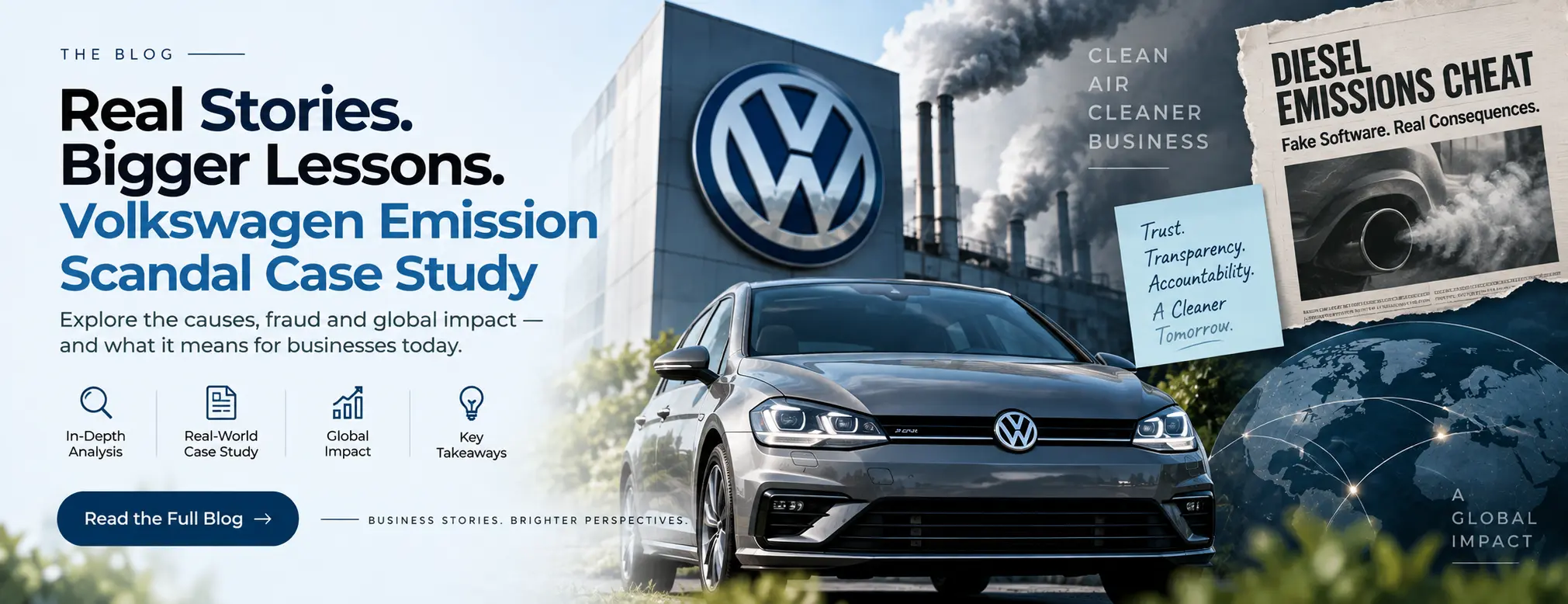
Volkswagen Emission Scandal Case Study: What Really Went Wrong
CA Archit Agarwal |
Mon, July 13, 2026
If someone asks what happened in the Volkswagen emissions scandal, the usual answer is pretty simple: Volkswagen cheated on an emissions test.
Technically, that's true. But it doesn't really explain how one of the world's biggest carmakers ended up in that position.
A closer look at this Volkswagen emissions scandal case study shows that Dieselgate wasn't just a story about dishonest software. There was a much bigger problem underneath it. Volkswagen had ambitious targets, difficult engineering requirements and a lot riding on its diesel strategy. Somewhere along the way, solving the problem became less important than making sure the problem wasn't visible.
That's what makes the case interesting from a business perspective. The software was the mechanism. The culture and decisions behind it were the real story.
Volkswagen Dieselgate Explained: What Actually Happened?
Certain diesel cars sold by Volkswagen, Audi and Porsche contained software known as a "defeat device." The software could recognize when the car was being tested for emissions.
During the laboratory test, the vehicle behaved one way. Its emissions-control systems worked hard enough for the car to meet the required standards.
Put the same car on an actual road, however, and things changed. Under normal driving conditions, the emissions controls could operate differently, resulting in much higher nitrogen oxide emissions. In some cases, emissions were found to be many times above the legal limit.
The U.S. Environmental Protection Agency identified around 590,000 affected vehicles in the United States. Volkswagen later acknowledged that approximately 11 million vehicles worldwide were associated with the EA 189 diesel engine involved in the scandal.
Now, cars don't always produce identical emissions in a laboratory and on the road. Real-world driving involves hills, traffic, acceleration, temperature changes, and countless other variables.
That wasn't really the issue here.
The problem was that the software was designed to recognize the test and make the vehicle behave differently during it. In other words, Volkswagen wasn't simply failing to meet the standard. It was creating the appearance of meeting it.
And that's a very different thing.
Why Did Volkswagen Cheat on Emissions Tests?
This is where the VW emissions scandal fraud becomes more interesting than the headline version of the story.
Volkswagen had invested heavily in diesel technology and wanted to make a bigger impact in the U.S. market. Diesel cars offered an attractive mix of fuel efficiency and performance, but meeting increasingly strict emissions requirements was hard.
The company was effectively trying to get several things at once: good performance, strong fuel economy, affordable vehicles, and low emissions.
Those goals created a difficult engineering problem.
There were legitimate ways of dealing with that problem. Volkswagen could have spent more money on development. It could have changed the engine design. It could have delayed a launch or accepted that some of its original targets weren't achievable.
None of those options were particularly attractive.
And this is where organizational pressure starts to matter.
Instead of treating the technical limitations as a problem that needed to be taken back to management, the company ended up finding a way to make the vehicles appear compliant.
That decision was far more damaging than simply missing a target would have been.
A failed engineering project can be redesigned. A delayed product can eventually be launched. A technology that costs too much can be replaced.
But once a company starts hiding the fact that something doesn't work, the problem changes completely.
Also read: Case Study Lehman Brothers: Causes, Collapse & 2008 Financial Crisis Lessons
How Did Volkswagen's Defeat Device Work?
The technology itself wasn't particularly mysterious once investigators understood what was happening.
The software was capable of identifying conditions associated with an emissions test. When those conditions were detected, the vehicle switched into a mode in which its emissions controls were more active.
The car could therefore produce emissions results that looked acceptable during testing.
When the test conditions disappeared, the vehicle could switch back to a different operating mode. Nitrogen oxide emissions then increased substantially.
It's worth separating the technology from the decision to use it.
Software controlling an engine isn't unusual. Neither is software changing how an engine behaves under different conditions.
What made this a problem was the purpose behind the software.
The system wasn't simply improving engine performance or managing emissions. It was being used to influence the outcome of an official regulatory test.
That is why the Volkswagen case has become such a widely discussed corporate ethics case study. The technology was sophisticated, but the underlying decision was fairly straightforward: instead of fixing the problem, hide it when someone is checking.
Also read: 10 Best AI Tools for Finance Professionals in 2026
Why Did Volkswagen's Internal Controls Fail?
This is probably one of the most uncomfortable questions for any large company studying the scandal.
Volkswagen wasn't operating without oversight. It had engineers, managers, compliance functions, legal teams and senior executives. There were plenty of people and departments that, at least in theory, were supposed to identify risks.
Yet the problem continued.
One explanation is the pressure created by the company's targets and internal culture. When a particular outcome is treated as non-negotiable, employees can end up focusing on how to achieve it rather than whether it is realistically achievable.
Imagine being the engineer who has spent months being told that the car needs to meet a particular performance and emissions target. You discover that the two requirements aren't working together as expected.
You have two choices.
You can go back upstairs and say, "We can't make this work without changing the cost, performance or timeline."
Or you can find another way to make the numbers look right.
The second option can start looking surprisingly attractive when the first one comes with the possibility of disappointing senior management.
That's the bigger lesson here.
Ethical failures don't always begin with someone sitting in a room and deciding to commit fraud. Sometimes they develop because an organization makes failure so uncomfortable that people start hiding it.
How Was the Volkswagen Emissions Fraud Discovered?
Interestingly, Volkswagen's own internal processes didn't uncover the problem.
Researchers from West Virginia University, working with the International Council on Clean Transportation, conducted real-world emissions testing using portable measurement equipment.
And the results didn't make sense.
The vehicles were producing emissions on the road that were dramatically higher than the laboratory results suggested. One model was found to exceed the applicable emissions limit by up to around 35 times during real-world testing.
The findings eventually reached California regulators and the U.S. Environmental Protection Agency.
This part of the story is particularly important for anyone looking at Volkswagen from a risk-management perspective.
The problem became visible when someone changed the way the vehicles were tested.
Inside the controlled laboratory environment, everything looked fine.
Outside it, the numbers told a completely different story.
That raises an obvious question: if an outside research team could identify the discrepancy by changing the testing environment, why didn't Volkswagen's own systems identify it earlier?
Having controls isn't the same as having effective controls.
Volkswagen Scandal Impact: What Did It Cost the Company?
The financial impact of the Volkswagen scandal was enormous.
In 2016, Volkswagen agreed to spend up to approximately $14.7 billion in U.S. settlements covering vehicle buybacks, compensation, and environmental remediation.
The following year, the company pleaded guilty to U.S. federal criminal charges and agreed to pay billions of dollars in additional criminal penalties and civil settlements.
Those numbers are obviously huge. But they're also the easiest part of the damage to measure.
The harder part was the loss of trust.
Volkswagen had spent decades building a reputation around German engineering, technical competence, and reliability. Customers weren't just buying a vehicle. They were buying into the idea that the engineering behind that vehicle could be trusted.
Dieselgate damaged that idea.
And unlike a fine, reputation doesn't come with a fixed price tag.
A company can pay a settlement and move on from the legal proceedings. Customers, investors, and regulators may take much longer to move on from the question of whether they can trust the company again.
Why This Is an Important Environmental Fraud Case Study
There is another part of the scandal that shouldn't get lost in the financial numbers.
This wasn't only a corporate or regulatory issue. It was also an environmental fraud case study because the consequences of excessive nitrogen oxide emissions extend beyond Volkswagen itself.
Air pollution doesn't care who owns the car.
If vehicles are producing significantly more pollution than regulators and consumers believe, the consequences can affect the wider public. That makes environmental misconduct particularly serious because the people dealing with the consequences aren't necessarily the people who made the original decision.
In that sense, Dieselgate wasn't simply a case of Volkswagen misleading regulators.
It also demonstrated how corporate decisions can push costs onto people outside the company.
Also read: Biggest Financial Frauds in History
What Can Businesses Learn From the Volkswagen Scandal?
There are some fairly practical lessons here.
First, regulatory requirements can't be treated as obstacles that exist simply to be worked around. If a company starts viewing compliance as a game of finding loopholes, it's already creating a problem.
Second, incentives matter more than companies sometimes admit. If employees are praised for hitting impossible targets but criticized for explaining why those targets don't work, the organization shouldn't be surprised when bad news stops travelling upward.
Third, independent testing is valuable. Internal teams can become too familiar with their own assumptions. Someone coming from outside the project may ask the obvious question that everyone else stopped asking.
Fourth, senior management needs to hear uncomfortable information. A workplace where every project is apparently "on track" isn't necessarily a healthy workplace. Sometimes it just means nobody wants to be the person delivering bad news.
And finally, companies need to remember that reputation is an asset. It can take decades to build and surprisingly little time to damage.
Check out: Free Finance Interview Resources
Frequently Asked Questions About the Volkswagen Emissions Scandal
What Is the Volkswagen Emissions Scandal in Simple Terms?
Volkswagen used software in certain diesel vehicles that could recognize when the vehicle was undergoing an emissions test. The vehicle would then activate stronger emissions controls and produce results that meet regulatory requirements. During normal driving, the system could operate differently, resulting in much higher nitrogen oxide emissions.
When Did the Volkswagen Emissions Scandal Happen?
The scandal became public in September 2015 after researchers discovered a major difference between laboratory emissions results and emissions measured during real-world driving. The software, however, had been used in affected vehicles for several years before the scandal became public.
Who Discovered the Volkswagen Emissions Fraud?
Researchers at West Virginia University, working with the International Council on Clean Transportation, identified the discrepancy through independent real-world emissions testing. Their work eventually led to scrutiny from California regulators and the U.S. EPA.
What Are the Main Ethical Lessons From the Volkswagen Scandal?
The biggest lessons involve organizational pressure, transparency and accountability. Volkswagen's experience shows how unrealistic targets and weak channels for escalating problems can create an environment where hiding a problem seems easier than admitting it.
It also shows why having compliance policies isn't enough. Employees need to feel that they can actually use those systems when something goes wrong.
The Bottom Line
The Volkswagen emissions scandal is often remembered as a story about a defeat device.
That's the easiest version of the story.
The more useful version is about what happened before the software was created.
Volkswagen had a difficult engineering problem. The company wanted its diesel vehicles to deliver performance, efficiency, affordability and regulatory compliance at the same time. When those objectives collided, the organization didn't handle the conflict particularly well.
Instead of saying that the target couldn't be met as originally planned, someone found a way to make the problem disappear during testing.
For a while, it worked.
Then an independent test changed the conditions, the numbers came out differently, and the entire thing unravelled.
That's why this Volkswagen emission scandal case study still matters. The lesson isn't that companies should avoid difficult targets. Difficult targets are part of business.
The lesson is what happens when an organization makes admitting failure more painful than hiding it.
A technical problem can usually be fixed.
A credibility problem is much harder to repair.
And by the time the Volkswagen scandal became public, the cost of hiding the original engineering problem was many times greater than the cost of simply admitting that the problem existed.