- Who Was Bernie Madoff?
- What Was the Bernie Madoff Ponzi Scheme?
- How Bernie Madoff Scam Worked?
- Why Did Investors Believe Madoff?
- What Is a Ponzi Scheme? Madoff as an Example
- How Much Money Did the Bernie Madoff Fraud Involve?
- Why Madoff's Scheme Collapsed in 2008?
- Bernie Madoff Ponzi Scheme Timeline
- Bernie Madoff Fraud Explained
- Warning Signs Investors Missed
- Biggest Ponzi Scheme in History: Why Madoff Was So Significant
- Lessons From Madoff Scam
- Legitimate Investment Operation vs. a Ponzi Scheme
- What Happened to Bernie Madoff and His Investors?
- FAQs
- Conclusion
↓
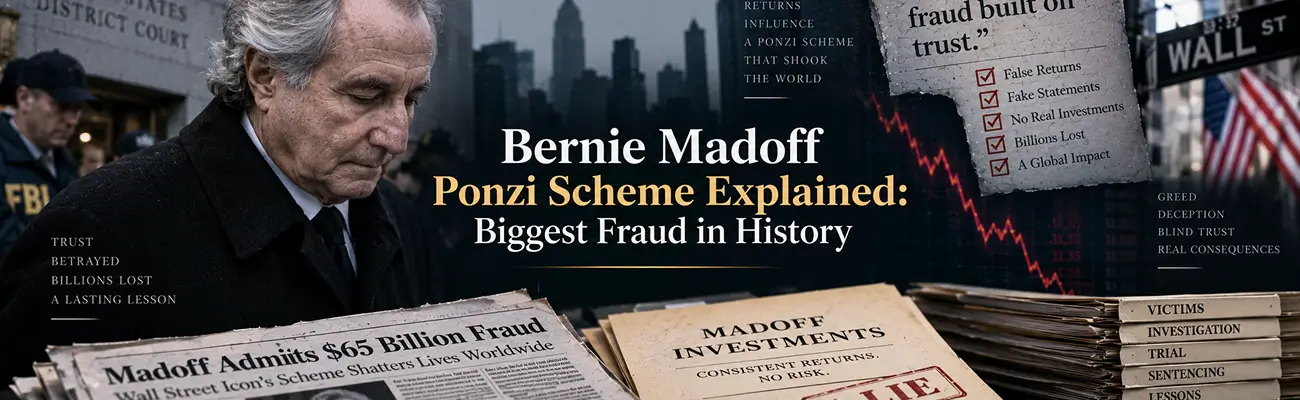
Bernie Madoff Ponzi Scheme Explained: Biggest Fraud in History
CA Archit Agarwal |
Sun, June 21, 2026
Picture a man who once chaired the NASDAQ, whose neighbors trusted him with their retirement money, whose own accountant friends invested with him without asking a single hard question. That's the setup that made the Bernie Madoff Ponzi scheme possible. Not a shady offshore operator promising 300% returns. A guy from Queens who built genuine credibility over decades, then quietly used it to run the most damaging Ponzi scheme regulators have ever documented.
By the time it fell apart in December 2008, the damage reached retirees who'd handed over their life savings, charities that had to shut their doors, and banks that should have known better. Here's the full story: how it started, how it actually worked month to month, and why nobody caught it until the money simply ran out.
Who Was Bernie Madoff?
Bernard Lawrence Madoff grew up in Queens and started his firm, Bernard L. Madoff Investment Securities LLC, in 1960 with money he'd scraped together from summer jobs like lifeguarding and installing sprinklers. Not exactly the origin story of a criminal mastermind. And for a long stretch, it wasn't one.
The firm turned into something real. Madoff got in early on electronic trading, back when Wall Street still ran mostly on paper and phone calls, and that gave him a genuine edge. He rose to chairman of NASDAQ at one point. He sat on regulatory advisory committees. People in the industry asked his opinion on how markets should be structured.
That résumé is the whole reason the fraud worked. Nobody double-checks a man they already respect.
Also read this: IL&FS Scam: Case Study of India's Biggest Financial Crisis
What Was the Bernie Madoff Ponzi Scheme?
Here's the part people often get wrong: Madoff didn't run one fake business. He ran two businesses under the same roof, and only one of them was fraudulent.
The trading arm, the market-making side that executed orders for other brokerages, was real. It made money the normal way. But tucked away on a different floor, with a separate staff who barely spoke to the rest of the firm, sat the investment advisory division. This is where clients handed over their money believing it was going into a strategy called "split-strike conversion," a real hedging technique that, on paper, was supposed to smooth out returns no matter what the market did.
In practice, that money mostly just sat in a bank account. There was no strategy running behind the scenes. When clients got their statements each month, they were looking at trades that had never happened, printed on paper that looked exactly like every other legitimate brokerage statement. When someone wanted to cash out, they got paid using money that had just come in from somebody else.
That's the engine underneath every Ponzi scheme, and it's why "the Madoff scheme" and "Ponzi scheme" have basically become interchangeable in conversation, even though the term itself comes from Charles Ponzi, who pulled a similar con in the 1920s, decades before Madoff was born.
Two Businesses, One Building
Worth separating clearly:
- The legitimate side - Madoff's market-making operation, which handled real trades for other firms and, by most accounts, ran as an actual profitable business.
- The fraudulent side - the investment advisory arm, operating almost like a separate company inside the same walls, where the money went in and the fake statements came out.
The real business wasn't just a side hustle. It was the cover story. It's what gave due diligence teams something legitimate to point to when they checked whether Madoff's firm was a real operation.
Also read this: Toshiba Scam: Accounting Fraud Explained with Causes & Impact
How Bernie Madoff Scam Worked?
Saying "he paid old investors with new investors' money" is true, but it's the summary, not the explanation. Here's what was actually happening behind the scenes, step by step.
- He made access feel exclusive, not for sale. Madoff never ran ads or pitched hard. He let his reputation travel through country clubs, synagogues, and tight social circles, often via existing clients or feeder funds that had a personal line to him. Some people who wanted in were turned away. That rejection did more marketing than any brochure could have.
- The returns were good, not outrageous. This detail fooled people who should have known better. He wasn't promising to double your money in a year. He was delivering something like 10 to 12 percent annually, year after year, with barely a losing month in decades. That steadiness read as credible in a way that flashy numbers never would have. A con that promises too much sets off alarm bells. A con that promises just enough doesn't.
- The paperwork did the lying for him. Every month, clients got statements listing specific trades, ticker symbols, dates, all fabricated to land on whatever return Madoff had already decided to report. The documents looked completely normal. Nobody had reason to dig deeper into something that looked exactly like what it was supposed to look like.
- Withdrawals worked like a shell game. Ask for your money back, and you got paid, but from cash that other clients had deposited recently, not from any actual investment gains. As long as new deposits outpaced withdrawal requests, the whole thing stayed liquid and invisible.
- It needed fresh money constantly, just to survive. There was no underlying portfolio generating real returns to draw from. Feeder funds became essential here, since they brought in large pools of client capital, often from investors who had no idea Madoff was the one actually managing it.
- The 2008 crash is what finally broke it. When markets tanked and panicked investors everywhere started pulling cash out of everything, Madoff's clients did the same. Redemption requests reportedly hit around $7 billion, an amount he had no way to cover, because there was no real portfolio sitting there to sell off.
Why Did Investors Believe Madoff?
A few things are coming together here. His Wall Street pedigree made skepticism feel almost rude. A former NASDAQ chairman isn't who most people picture when they imagine a con artist. His legitimate trading business gave outside due-diligence checks to a real company to verify, which quietly vouched for the fraudulent side sitting right next to it.
Then there's the auditor. Madoff's fund, worth billions, was audited by a tiny, obscure accounting firm working out of a small office. In hindsight, that's about as loud a red flag as it gets. But most investors never asked who audited the fund. They leaned on something much less rigorous: other smart, wealthy people they already trusted were in, so it must be fine. That's not due diligence. That's peer pressure wearing a suit.
What Is a Ponzi Scheme? Madoff as an Example
Strip away the jargon and a Ponzi scheme is simple: it's a fraud where the "returns" paid to early investors come from money deposited by later investors, not from any real profit-generating activity. There's no actual business underneath making that money. The whole thing survives only as long as new cash keeps arriving fast enough to cover what's going out.
If you want the clearest, what is Ponzi scheme example available, Madoff is it. Fabricated returns, fake documentation, later investors quietly funding earlier ones, a collapse the moment withdrawals outpaced deposits. Every box, checked. What made his version different from the typical Ponzi scheme wasn't the mechanics. It was how long he kept it running. Most schemes like this get caught within a few years. Madoff's lasted for decades, propped up by a reputation nobody wanted to question.
How Much Money Did the Bernie Madoff Fraud Involve?
The numbers reported for this case genuinely depend on which number you're looking at, and that's worth clearing up. Prosecutors cited a figure around $65 billion, but that reflects the fabricated account balances clients believed they had, including years of fake "gains" that were never real to begin with.
The actual cash investors put in and lost, meaning real principal rather than invented profit, has been estimated by court-appointed trustees at somewhere between $17 billion and $20 billion. Trustee Irving Picard has spent years clawing that money back through lawsuits and settlements, recovering more than $14 billion for victims so far.
Two very different numbers, both technically "the size of the fraud," depending on what you're measuring. That's why headlines about Madoff's losses don't always agree with each other.
Why Madoff's Scheme Collapsed in 2008?
The whole structure ran on one requirement: new money coming in faster than money going out. During a rising market, that's not hard to pull off, since most clients are adding to their accounts rather than draining them.
The 2008 financial crisis flipped that completely. As markets crashed worldwide and everyone scrambled for cash, Madoff's clients started requesting withdrawals at a scale the scheme had never had to absorb before.
By early December 2008, he couldn't meet roughly $7 billion in redemption requests. On December 10, he told his sons Mark and Andrew, both of whom worked on the legitimate side of the firm, that the advisory business was "basically a giant Ponzi scheme" and that it was "all just one big lie." They called a lawyer. The lawyer reported it to the SEC. FBI agents showed up at Madoff's Manhattan apartment the next morning, December 11, 2008, and arrested him.
Twenty years of fabricated statements, undone in the span of about 24 hours.
Bernie Madoff Ponzi Scheme Timeline
| Period | Event |
|---|---|
| 1960 | Madoff founds Bernard L. Madoff Investment Securities LLC |
| 1970s-1980s | The firm grows into a genuinely respected market-making business; Madoff gains real influence at NASDAQ |
| 1990s-2000s | The fraudulent advisory arm expands sharply, fueled by feeder funds |
| Late 1990s-2000s | Analyst Harry Markopolos repeatedly warns the SEC that Madoff's returns are mathematically impossible |
| 1992, 2005, 2006, 2008 | SEC investigates Madoff or people connected to him multiple times, and misses the fraud every time |
| December 10, 2008 | Madoff confesses to his sons that the business is a Ponzi scheme |
| December 11, 2008 | FBI arrests Madoff at his Manhattan apartment |
| March 12, 2009 | Madoff pleads guilty to 11 federal felony counts |
| June 29, 2009 | Sentenced to 150 years in federal prison by Judge Denny Chin |
| December 11, 2010 | His son Mark dies by suicide, exactly two years to the day after the arrest |
| April 14, 2021 | Madoff dies in the Federal Medical Center in Butner, North Carolina, at age 82 |
Bernie Madoff Fraud Explained
| Item | Details |
|---|---|
| Firm | Bernard L. Madoff Investment Securities LLC |
| Fraud type | Ponzi scheme run through the investment advisory division |
| Reported fabricated value | Around $65 billion in fictitious account balances |
| Estimated actual cash losses | Roughly $17-20 billion in real investor principal |
| Amount recovered by trustee so far | More than $14 billion |
| Duration of fraud | Multiple decades, accelerating through the 1990s and 2000s |
| Charges | 11 felony counts, including securities fraud, wire fraud, mail fraud, and money laundering |
| Sentence | 150 years in federal prison |
| Notable investors affected | Individuals, charities, pension funds, and public figures including Steven Spielberg, Kevin Bacon, and Sandy Koufax |
Warning Signs Investors Missed
- Returns that barely moved. Real strategies tied to actual markets have bad months. Madoff's fund reported gains almost every single month for years, a pattern that's close to statistically impossible for anything trading real securities.
- An auditor almost nobody had heard of. A fund managing billions was signed off by a three-person accounting firm working out of a small suburban office, not one of the major firms you'd expect for a fund that size.
- No independent custodian. Madoff's own firm held custody of client assets rather than routing that job to an outside custodian, which erased a layer of checking that should have existed.
- A strategy he refused to explain in detail. Ask Madoff exactly how the split-strike conversion approach worked and you got vague answers, framed as proprietary information he couldn't share. That's a strange level of secrecy for a fund manager.
- Feeder funds with all their eggs in one basket. Several funds funneled nearly everything they managed straight to Madoff, with little transparency to their own investors about where the money actually went.
- Direct tips to regulators that went nowhere. Harry Markopolos handed the SEC detailed, math-backed complaints explaining why the returns couldn't be real. The agency investigated and still missed it, more than once.
Also read this: Luckin Coffee Fraud: Case Study of Fake Revenue & Accounting Scandal
Biggest Ponzi Scheme in History: Why Madoff Was So Significant
Calling Madoff's fraud the biggest Ponzi scheme in history is accurate, but it's worth being precise about what that means. By total scale and by how long it ran undetected, it's the largest Ponzi scheme regulators have ever uncovered, and it isn't close. That's a specific claim about Ponzi schemes as a category. It's not the same as saying it's the single largest financial fraud ever committed in any form, since accounting frauds like Enron are structured completely differently and get measured on different terms.
What actually sets Madoff apart isn't just the dollar figure. It's the combination of scale, decades of duration, and the fact that a former NASDAQ chairman ran the whole thing in plain view of regulators who investigated him repeatedly and still walked away empty-handed.
Lessons From Madoff Scam
- Suspiciously steady returns are a red flag, not a relief. Markets move. A fund that never seems to have a bad month deserves harder questions, not less scrutiny.
- Reputation isn't evidence. Madoff's résumé was convincing that actual verification should have been done. A track record of respect isn't the same as a track record of proof.
- Custody should sit somewhere independent. When the same person managing your money is also the one reporting your balance back to you, there's no outside check on whether that number is even real.
- A manager who won't explain the strategy clearly is asking for blind trust. Vague answers about "proprietary methods" shouldn't be enough to satisfy a serious investor.
- The auditor should match the size of the fund. A tiny, obscure firm auditing a multibillion-dollar operation is a mismatch that deserves its own investigation, on its own.
- Spreading money across managers limits the damage. Investors and feeder funds that put almost everything into Madoff alone had no cushion when the fraud finally surfaced.
- Paperwork can be faked convincingly. Verify independently when you can. The statements looked real because they were built to look real. The people who eventually raised the alarm did so by checking the numbers themselves, not by trusting the documents.
- "Everyone I know is invested" is not due diligence. It was one of the most common reasons people gave for skipping their own research, and it turned out to be exactly the wrong instinct to follow.
Legitimate Investment Operation vs. a Ponzi Scheme
| Feature | Legitimate Investment Operation | Ponzi Scheme |
|---|---|---|
| Source of returns | Real market activity, business profits, or asset growth | Cash from newer investors, not actual earnings |
| Custody of assets | Held by an independent third-party custodian | Often held directly by whoever's running the fund |
| Auditing | A reputable firm sized appropriately for the fund | Little to no meaningful independent audit |
| Return pattern | Fluctuates along with the market | Oddly steady or consistently positive |
| Transparency | Clear, verifiable explanation of strategy and holdings | Vague, "proprietary," or deliberately unclear |
| Sustainability | Doesn't need constant new money to survive | Collapses the moment new inflows slow down |
What Happened to Bernie Madoff and His Investors?
Madoff pleaded guilty in March 2009 to 11 federal felony counts: securities fraud, wire fraud, mail fraud, and money laundering among them. That June, he was sentenced to 150 years in prison, the maximum the law allowed, with the judge describing his crimes as extraordinarily evil. He served the sentence at a federal correctional complex in Butner, North Carolina, and died there in April 2021 at age 82.
His firm's assets were seized and liquidated. A court-appointed trustee has spent years chasing down lawsuits against banks, feeder funds, and individuals who profited from or enabled the scheme, recovering more than $14 billion for victims along the way. His son Mark died by suicide in December 2010, exactly two years after his father's arrest. Thousands of investors, from individual retirees to major charitable foundations, lost money that in many cases has never been fully returned.
FAQs
1. What was the Bernie Madoff Ponzi scheme?
A decades-long fraud where Madoff's investment advisory arm paid "returns" using new clients' deposits instead of any real trading, all backed by fabricated account statements.
2. How did the Bernie Madoff scam actually work?
Clients believed their money was in a hedging strategy called split-strike conversion. It mostly just sat in a bank account. Monthly statements showed trades that never happened, and withdrawals were paid out using other clients' fresh deposits.
3. How much money did Bernie Madoff steal?
Prosecutors cited around $65 billion in fabricated account balances, but that includes years of fake gains. The real cash investors lost is estimated at $17-20 billion, of which trustees have recovered more than $14 billion so far.
4. Why did it take so long to catch Bernie Madoff?
His Wall Street reputation, a real trading business next door to the fraud, and a peer-pressure effect- other trusted, wealthy people were in, so it must be fine- kept scrutiny away. The SEC even investigated him multiple times and missed it every time.
5. What caused Madoff's Ponzi scheme to collapse?
The 2008 financial crisis. Clients rushed to withdraw around $7 billion, far more than the scheme could cover since there was no real portfolio behind it.
6. What happened to Bernie Madoff?
He pleaded guilty in 2009 to 11 felony counts, was sentenced to 150 years, and died in federal prison in April 2021 at age 82.
Conclusion
The Bernie Madoff Ponzi scheme didn't run on complicated financial engineering or some genius-level trick nobody could have spotted. It ran on trust, borrowed from a legitimate business, dressed up with paperwork that looked exactly like the real thing, and calibrated to feel believable instead of greedy. That's the whole trick.
Which is really the part worth sitting with. The mechanics weren't exotic at all. What kept it running for over twenty years was how ordinary the whole thing was allowed to look, right up until the money simply stopped showing up.
About Author