- Quick Summary Box
- What Was Luckin Coffee?
- Luckin Coffee vs. Starbucks: Why the Comparison Stuck?
- How the Fraud Worked: A Fake Revenue Fraud Case Study
- Luckin Coffee Fraud Timeline
- Red Flags That Were Missed
- Financial Statement & Standards Impact
- Fraud Triangle, Fraud Diamond and GONE Theory Analysis
- Who Discovered the Fraud?
- Consequences of the Luckin Coffee Scandal
- Conclusion
- FAQs
↓
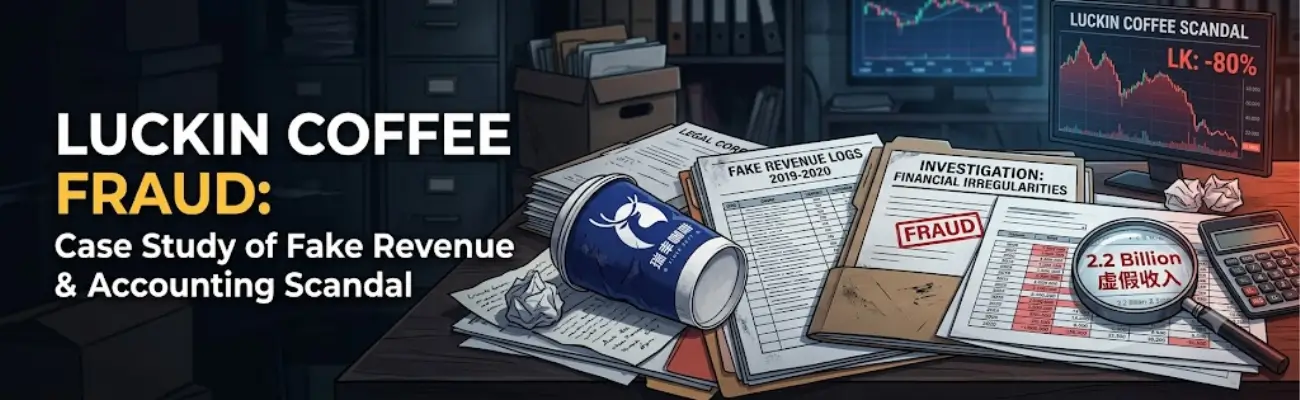
Luckin Coffee Fraud: Case Study of Fake Revenue & Accounting Scandal
CA Archit Agarwal |
Sat, June 13, 2026
In May 2019, a Chinese coffee chain called Luckin Coffee, listed on the Nasdaq, raised over $561 million from investors and told the world it would outcompete Starbucks at its own game. Then, 11 months later, it acknowledged that significant portions of the revenues in that story never actually existed. The ultimate issue in the Luckin Coffee fraud was admission: an extra $310 million in sales created out of thin air, through a network of coupons, shell companies, and related-party transactions. In a single session, the stock dropped over 80%, and the company was delisted from Nasdaq within a few weeks.
The "Luckin Coffee fraud" is one of the easiest-to-understand case studies on the market, not because it was well-thought-out and clever, but because it was not. It operated as long as it did due to the lack of scrutiny. This article is possibly the Luckin Coffee scandal explained at its core: What exactly was the company, how was the fraud built, who did notice it, and what does it imply for accounting standards and audit practice? It is also a fake revenue fraud case study and one of the most helpful accounting fraud examples start-up founders can learn from, due to its simplicity and easy-to-follow process from start to finish.
Quick Summary Box
| Particular | Details |
|---|---|
| Company | Luckin Coffee Inc. |
| Country | China (Cayman Islands incorporated, listed on the Nasdaq) |
| Industry | The world of retail coffee/F&B and delivery via apps |
| Fraud Type | Retail sales, expenses, and round-tripping with related parties fabricated |
| Fraud Amount | $310 million in fabricated 2019 sales; expenses inflated by over $190 million |
| Discovery | Confirmed in an 89-page Muddy Waters Research report (January 2020) and as a result of an internal investigation and external audit. |
| Main People Involved | The COO, Jian Liu, the CEO, Jenny Zhiya Qian, and shell companies related to the company. |
| Regulatory Action | The market regulator in China has fined the Luckin entities and 43 related parties about $9 million, while the SEC has imposed a $180 million fine |
| Outcome | Chapter 15 bankruptcy, management changes, a potential restructuring, and even a full business recovery by 2023–2026. |
What Was Luckin Coffee?
Luckin Coffee was established in October 2017 in China on a simple premise. China's coffee consumption is much lower than that of the US or Europe, because it's too inconvenient and too expensive. So Luckin constructed a company based on neither. No cashiers; all orders are paid through Alipay or WeChat Pay. Rather than big sit-down cafes, most outlets were small pickup/delivery-only kiosks, which kept real estate and staffing costs low.
However, to attract the interest of the customers, Luckin heavily relied on discounting: free first cups, buy-one-get-one discounts, and very deep couponing on nearly all products. Even though it was successful on paper.
By the end of 2019, the company's store count had grown to over 4,500, surpassing Starbucks' store base in China. Investors were equally quick to latch on to the growth story: Luckin's valuation skyrocketed from around $1 billion mid-2018 to nearly $4 billion by May 2019, when it appeared on Nasdaq with a share price of $17, raising in the IPO itself approximately $561–645 million. By the time the fraud was exposed, the company had raised a whopping $864 million from investors, including later debt and equity raises.
Did You Know? Luckin's flurry of activity, which included its listing on the Nasdaq in May 2019, was then one of the fastest by a Chinese firm to list on a US exchange, from the day of its formation to the Nasdaq's bell ringing in less than 19 months.
A Quick Look At Luckin's Business Model
| Element | Description |
|---|---|
| Ordering | App-based – No cash counters. |
| Store format | Not big cafés, but small pickup stores and strictly delivery-only stores. |
| Pricing strategy | It is called "heavy couponing" when both the first order is free and every item comes with a buy-one-get-one agreement. |
| Payment | The integration of Alipay / WeChat Pay. |
| Growth strategy | The number of stores has grown quickly, and with the help of outside capital, not profits. |
| Target customer | Price-sensitive, tech-savvy, urban Chinese consumers |
Luckin Coffee vs. Starbucks: Why the Comparison Stuck?
The comparison was intentional, as Luckin's entire investment offering to investors was: Starbucks sells an experience; we'll sell a habit—faster, cheaper, and via an app.
The scandal wasn't the most exciting thing that ever happened, but before the event it was a very interesting tale, and much of the coverage had the impression Luckin was the company that would make good on its promise of 'breaking China's coffee market.'
| Parameter | Luckin Coffee | Starbucks |
|---|---|---|
| Pricing | Aggressive, coupon-driven, ~30–50% cheaper | Premium pricing |
| Store strategy | Little seating and high density of small kiosks. | Large cafés, "third place" experience |
| Technology | Ordering is done by app, cashiers not available. | App ordering as add-on, cashiers retained |
| Expansion speed | 4,500+ stores in ~2 years | Decades to achieve the same kind of China impact. |
| Target audience | Cost-conscious, convenience-driven urbanites | Aspirational, experience-seeking customers |
| Revenue model | Volume-led, subsidised unit economics | Margin-led, brand-premium pricing |
An outside auditor should have noticed this trend in growth by itself. If stores are growing at this rate and the firm is selling product at a loss, they are the type of patterns that analytical review procedures are meant to detect. The Luckin Coffee vs Starbucks case appears to have been a rather unfair battle on fundamentals in hindsight, since nearly half of the reported revenue for Luckin in 2019 was fraudulent.
Auditor's Note: Such a growth rate on its own is a red flag in the analytical review procedures because it's extremely fast and capital-intensive growth at a time when the company is also offering very high discounts to customers.
How the Fraud Worked: A Fake Revenue Fraud Case Study
Strip away the complexity, and the Luckin coffee fraud ends up being a single concept: create the illusion of a customer demand that is essentially nonexistent, and record it as revenue.
The main method for Luckin to do this was via its coupon and voucher system. This was done by Luckin with the same approach they used to attract real customers: using a coupon and voucher system to create fake customers. From April 2019, Luckin's employees began to make up the coupon sales and redemptions in a series of three fraudulent schemes with individual customers, corporate customers, and resale shell companies.
In simple terms:
- Fake customers— Those who falsified accounts and purchased fake coupons from their own pocket and then "redeemed" the coupon to create fake orders went to work with relatives and created accounts.
- Fake corporate buyers – Related-party companies had purchased bulk coupons, but the coupons were not purchased by the real customers.
- Fake shell-company resale – The largest and final scheme, the vast majority of the artificial revenue was channeled through shell companies pretending to be independent coupon resellers.
- Round-tripping—Transferring funds from accounts that are linked to Luckin back into Luckin's books through such middlemen, giving the impression of arm's length, independent sales.
- Expense Inflation— Advertising, raw material, and delivery prices were inflated at the same time to make the margins appear realistic and to obscure where the bogus money was going.
Key Insight: It was not a one-off tweak for one quarter that was used to meet the target. It was a self-reinforcing scheme that had to continue to expand quarterly to sustain the company's growth narrative it had pledged to investors.
Also read this: Satyam Scam Explained: India’s Biggest Accounting Fraud
Luckin Coffee Fraud Timeline
| Year / Date | Event |
|---|---|
| October 2017 | Charles Zhengyao Lu and Jenny Zhiya Qian founded Luckin Coffee in China. |
| 2018 | Valuation rises from about $1 billion to $2.9 billion in a matter of months as the rapid rollout of stores begins. |
| May 2019 | Luckin IPOs on Nasdaq, raising over $560 million; stores exceed 2,300 |
| April 2019 – January 2020 | The SEC has found that the fabricated sales scheme is actively operating. |
| 31 January 2020 | Muddy Waters Research releases an anonymous 89-page report alleging fake sales |
| 3 February 2020 | Luckin officially refuses to acknowledge any of the claims. |
| 2 April 2020 | Luckin says it has faked some RMB 2.2 billion ($310 million) worth of sales in 2019, and its stock drops 80% or more during one session. |
| May 2020 | CEO Jenny Zhiya Qian and COO Jian Liu are fired and resign from the board |
| 15 May 2020 | The Nasdaq will issue a delisting notice. |
| July 2020 | Chairman Charles Zhengyao Lu is dismissed from the board of the company. |
| 13 July 2020 | Luckin's trading is suspended on the ADS, and it is formally delisted from the Nasdaq. |
| September 2020 | China's market regulator fines Luckin entities and 43 related third parties roughly $9 million |
| 16 December 2020 | The SEC has agreed to a civil penalty of $180 million with Luckin |
| February 2021 | Luckin seeks Chapter 15 bankruptcy protection in the US |
| 2021–2022 | Court-approved debt restructuring, a rough $175 million shareholder class-action settlement reached, and management were completely replaced. |
| 2023 | China's biggest coffee shop, Starbucks, is surpassed by Luckin. |
| June 2025 | Luckin's first U.S. outlets are opened in Manhattan, a symbolic move back to the American market. |
| Present (2026) | Luckin is said to be dipping into a new US listing and has about 30,000 shops globally. |
Red Flags That Were Missed
| Red Flag | Why It Mattered |
|---|---|
| Growth is far outstripping China's real consumption trends. | Growth that doesn't align with actual demands is not organic growth, and that is something that is rarely seen. |
| Widely relying on a selling approach, based on coupons. Strongly using a coupon-based selling approach. | Discounted "revenue" is easier to make up than it is to verify. |
| If the number of foot traffics is inconsistent with the reported order volumes, then store it. | Muddy Waters used thousands of hours of surveillance footage to show traffic couldn't support reported sales. |
| The transactions with related parties are rapidly growing. | An old-fashioned way of doing round-tripping. |
| Fraud discovered only at the time of the annual external audit, not by other internal governance arrangements | Indicators of poor internal controls leading up to the audit. |
Financial Statement & Standards Impact
Luckin both overstated its revenue by around 28% for the first quarter of 2019 and 45% for the second quarter of 2019 while understating its net loss in those quarters, the SEC said. All ratios derived from that revenue were skewed, and that is precisely how the valuation fall was so dramatic when it truly hit.
Essentially, this was a simple failure to adhere to the basic principles of revenue recognition (in line with the principles of IFRS 15 / ASC 606, revenue is only recognized once control of goods or services has been transferred); disclosure requirements involving related parties; and the provisions of the SEC's antifraud, reporting, books and records, and internal-control provisions of US federal securities law.
Which Accounting Standards and Governance Principles Violated?
- Revenue recognition concepts (similar to IFRS 15 / ASC 606): Revenue is only recognized when the seller has transferred control of the goods/service to the customer. Luckin accounted for any transactions that were not orders, deliveries, or customer redemption.
- US GAAP disclosure and reporting requirements: Luckin was a foreign private issuer listed on the Nasdaq and was required to comply with the antifraud provisions of Section 17(a) of the Securities Act of 1933 and Section 10(b) of the Securities Exchange Act of 1934, as well as the reporting, books-and-records, and internal-control requirements of the Exchange Act.
- Disclosure of related party transactions: Related party transactions were not adequately identified and disclosed as transactions with related parties.
- Corporate Governance Principles: The Board's Audit Committee did not identify a scheme that operated over three full quarters until it was identified during the annual external audit.
- Audit implications: This case serves as an example of the importance of analytical procedures, the need to map related parties, and the importance of confirming revenue (which is not the same as obtaining the information from operational databases provided by the management).
Fraud Triangle, Fraud Diamond and GONE Theory Analysis
Fraud Triangle
Luckin nearly completely fits the traditional fraud triangle, which consists of pressure, opportunity, and rationalization.
| Element | Application to Luckin |
|---|---|
| Pressure | Rocket-stacked investor hopes associated with an aggressive growth plan that was publicly announced after a record-setting IPO. |
| Opportunity | Weak independent oversight, the centralization of control in the insiders of related companies, and a revenue model based on coupons which was difficult to audit from the outside |
| Rationalisation | Executives could rationalise the “real” business would catch up with the reported business later on — an explanation that is often used in growth-stage frauds |
Fraud Diamond (adds Capability)
In addition to pressure, opportunity, and rationalization, the fraud diamond includes capability—the personal attributes required to successfully make a scheme this complicated work. Luckin's senior operators had a decade of combined experience in operating fast-growing, tightly managed companies, both sides (CAR Inc. and UCAR), and had the operational know-how, cross-company relationships, and control over financial systems necessary to develop and operate a multi-layered, database-level concealment scheme.
GONE Theory
The GONE theory breaks the same behavior down into four factors: greed, opportunity, need, and exposure. These factors explain not only how the fraud began, but also why it kept growing.
| Factor | Application to Luckin |
|---|---|
| Greed | A desire to maintain a multi-billion dollar value and personal wealth based on that. |
| Opportunity | Operational Data and related-party counterparties under the control of insiders |
| Need | An increase in pressure to achieve rapid growth in order to justify the valuation set at IPO. |
| Exposure | Low risk of detection with limited independent oversight of a rapidly expanding foreign private issuer |
Who Discovered the Fraud?
On January 31, 2020, short seller Carson Block and his research firm Muddy Waters Research released an anonymous 89-page report claiming Luckin had cooked the books. The report was based on approximately 11,260 hours of surveillance footage and was believed to have reported that sell-through had been overstated by at least 69% in Q3 and 88% in Q4 2019.
First of all, Luckin denied every allegation. However, the tip-off was from a completely different source: The offending occurred while conducting its own annual external audit of Luckin. This led to a full internal investigation, conducted by a special committee with independent outside counsel Kirkland & Ellis and independent forensic accounting expert FTI Consulting. This investigation affirmed the fabricated transactions, and the company reported the issue to, and cooperated with, both the SEC and Chinese regulators.
The pattern here is common to large frauds: outside short sellers sue, the company denies it, and the matters in the statutory audit process prove their allegation correct. It highlights the need for the external audit reports to be independent and for the auditors to display a certain professional skepticism, even if the alarm is raised by activist research.
Consequences of the Luckin Coffee Scandal
The fallout reached well beyond Luckin's own leadership, touching everyone from retail investors to Chinese regulators.
| Stakeholder | Impact |
|---|---|
| Investors | The scandal drove down shares by more than 80% in one day, and it drew attention to the need for strong governance, raising the bar for corporate fraud in China for those companies that have Chinese ties. Billions of dollars were wiped from the market, and shareholders have been given a $175 million class-action cash settlement. |
| Employees | Twelve senior workers linked to the schemes lost their jobs or had them suspended, while thousands of store employees were put at risk during the bankruptcy. |
| Management | The CEO, COO, and Chairman were all sacked, continuing reputational and legal liability. |
| Auditors | Increased global focus on audit quality for Chinese companies listed in the US; focus on PCAOB access to Chinese audit work renewed. |
| Regulators | Both the SEC and Chinese regulators were forced to publicly explain how they enforce cross-border private issuer fraud. |
| Customers | Minimal direct impact — services continued via the app after the corporate restructure |
Conclusion
The Luckin Coffee fraud is one of the biggest corporate scandals in the last decade. If you're seeking information on the Luckin Coffee scandal explained, financial reporting lessons from accounting fraud examples in startup businesses, or analyzing a fake revenue fraud case study, this incident can provide you with extensive lessons in auditing, ethics, governance, and financial reporting.
Additionally, it also turned the Luckin Coffee vs. Starbucks case into a tale of corporate fraud in China, of independent oversight, and of the competition of markets. It's one of the accounting fraud examples startup ecosystems have when they're talking about governance issues at the growth stage. It's a real-world illustration of the actual mechanics of fictitious revenue recognition and related party round-tripping for CA students and auditors—and why analytical procedures and professional skepticism are no frills; they're the whole beat.
FAQs
1. What was the Luckin Coffee fraud?
Luckin created more than $300 million of 2019 retail sales through a related party shell company arrangement via fake coupon redemptions.
2. Who discovered it?
In January 2020, Muddy Waters Research, a short-seller, sounded an alarm, and the external auditors' report on Luckin confirmed the same.
3. What will Luckin have to pay as a fine?
In December 2020, a $180 million civil penalty was paid to the SEC.
4. Is Luckin Coffee still in business?
Yes—it restructured, emerged as China's largest chain by 2023, and it went global with its first stores in the U.S. in 2025.
5. What accounting technique did Luckin use?
Funds are transferred through shell companies to simulate independent sales, and there is fictitious revenue recognition.
6. How is this different from Enron's fraud?
While Enron used complicated off-balance-sheet accounting, Luckin employed a more basic, high-volume fake-sales approach.
7. What's the biggest lesson for CA students?
The ease with which those “fictitious revenue” schemes can grow to many hundreds of millions of dollars when there is weak related-party oversight and independent verification.
8. Did Luckin's stock really crash 80% in one day?
Yes, when it was confirmed that the $310 million fabrication was indeed real, it instantly made the growth story of the entire valuation go down the toilet.
About Author