- What Is Professional Skepticism in Auditing?
- Is Professional Skepticism Important in Auditing?
- Key Behaviours of Professional Skepticism
- Professional Skepticism SA 200: What the Standard Actually Says?
- Professional Skepticism Examples in Auditing
- How Professional Skepticism Works Through an Audit?
- Professional Skepticism vs Professional Judgment
- FAQs About Professional Skepticism in Auditing
- Conclusion
is-dark-text">

↓
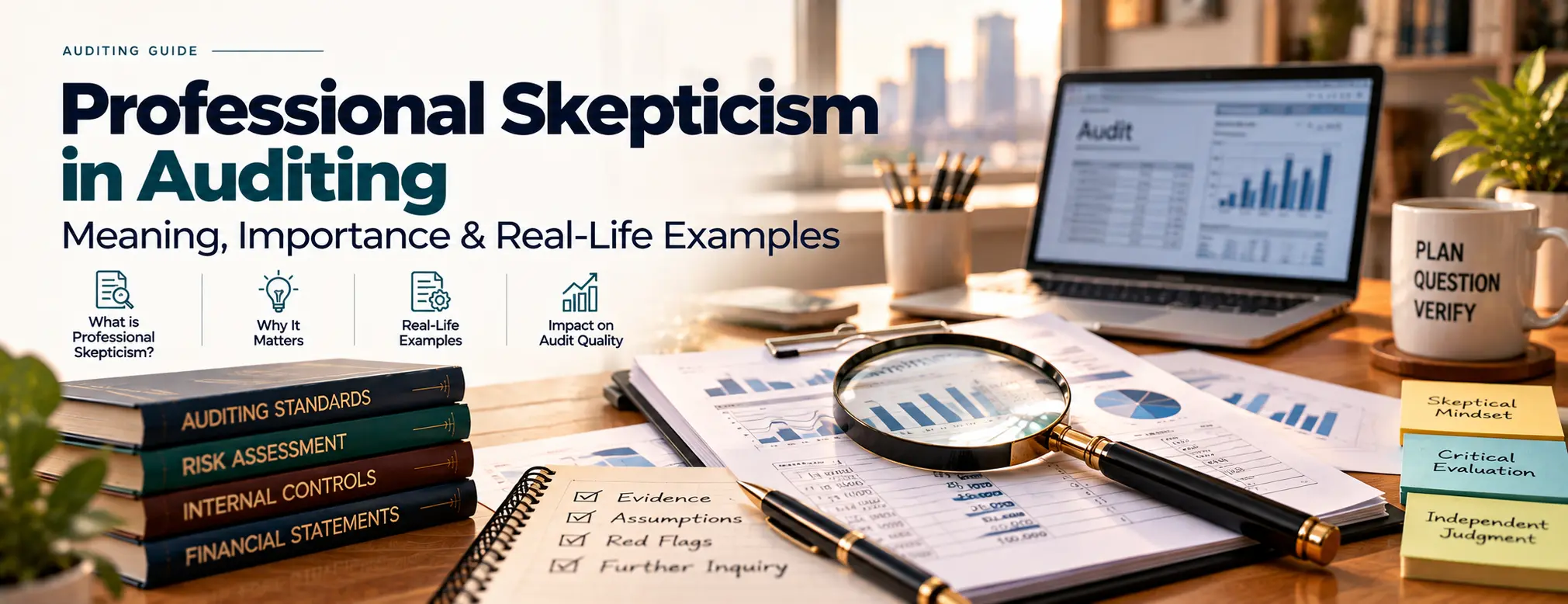
Professional Skepticism in Auditing: Meaning, Importance & Real-Life Examples
CA Archit Agarwal |
Tue, September 1, 2026
An audit may seem like a great deal on paper, and yet there's something it missed. However, if no one asks what they are being presented with, a real problem can seep through despite numbers matching, management responses being almost flawless, and everything appearing flawless. That's why the importance of professional skepticism in auditing is great. It's not taking anything for granted because it seems right.
This article explains what it is, why it's important, its implications in the context of SA 200, and its manifestation during an audit.
What Is Professional Skepticism in Auditing?
Professional skepticism is an attitude in which the auditor challenges evidence rather than taking it at face value. It's not that you don't trust anybody. It's just a matter of verifying before you assume.
Simply put, the auditor will not assume that management is dishonest, nor will he assume that management is honest. The auditor examines the evidence and then makes his judgment.
This attitude needs to remain constant throughout the planning process and until the initial sign-off. Many auditors are good at the beginning, and go slack at the end. This is when things go astray.
Is Professional Skepticism Important in Auditing?
Most audit failures happen because someone accepted an explanation too quickly. That's really the importance of professional skepticism in one line: it catches things before they become bigger problems.
Here's where it matters most:
- Material misstatements – Small errors can snowball if nobody checks them closely
- Fraud – Usually hidden behind an explanation that sounds completely normal
- Management bias – Numbers can lean in a favourable direction without being technically wrong
- Unusual transactions – Deals near year-end deserve a second look
- Weak or conflicting evidence – If two things don't match, that gap needs an answer
- Accounting estimates – Built on assumptions, and assumptions can be one-sided
These situations show up in almost every audit, which is why skepticism can't be a one-time effort.
Key Behaviours of Professional Skepticism
These key behaviours show up as specific actions during fieldwork.
- Asking why a number looks the way it does
- Staying alert to anything unusual, odd timing, missing paperwork
- Judging whether evidence is reliable, not just whether it exists
- Being willing to push back on management when needed
- Remembering that trust doesn't replace proof
- Holding the same standard from start to finish, not just at the beginning
Professional Skepticism SA 200: What the Standard Actually Says?
According to ICAI, SA 200 is the standard that formally introduces this idea. It describes professional skepticism as an attitude built on a questioning mind, alertness to signs of possible misstatement due to error or fraud, and careful evaluation of evidence.
The standard requires auditors to plan and perform the entire audit with this mindset, because there's always a chance the financial statements could be wrong. It also points to specific triggers, evidence that contradicts other evidence, documents that seem unreliable, or anything hinting at fraud.
One important point from professional skepticism SA 200: even if the auditor trusts management, that trust doesn't lower the amount of evidence needed. A good relationship with a client is never a substitute for actual proof.
SA 200 also mentions professional judgment alongside skepticism. They're related, but not the same thing; more on that below.
Professional Skepticism Examples in Auditing
This can be explained a lot better by real situations than by the definitions. Here are some typical examples of professional skepticism auditors face.
Sales rose sharply at the end of the year. If the sales curve jumps upward just prior to the end of the year, it may be a case of the book being too early. Typically, it is settled by reviewing shipping logs and/or customer confirmations.
Stock that does not correspond with the sales figures. When stock levels go up for no apparent reason, the physical count and a check of old unsold stock verify the stock.
Overstated estimates that are always in its favor. The judgment associated with bad debt or asset value estimates. If they are continually working out in the company's favour, the assumptions on which they are based must be challenged, not the maths.
Related-party deals. These might not be the normal market prices, and it may be worthwhile to compare these against similar offers by external parties.
Conflicting explanations. The distinction between what two people in the same company say about an event must be settled by means of records, not by just talking.
Unusual journal entries. Entries received at odd hours of the day or by persons who do not routinely handle books should be examined.
Any information that disputes what is being said by management. In the event that a written representation is not consistent with the bank confirmation, the issue should be addressed, not resolved.
Also read: Top 7 Industries Hiring Internal Auditors in 2026
How Professional Skepticism Works Through an Audit?
Using professional skepticism in the audit process takes on a slightly different form at various stages. It helps to determine what risks are flagged during planning. In the field, it's asking more questions when the current response is not enough. In examining an estimate, it is not only about checking the numbers, but it is also about asking questions about the assumptions. Toward the end, it's asking if evidence is actually substantiating the last opinion.
As the team becomes busier, the attention never goes away; otherwise, the audit isn't being conducted right.
Professional Skepticism vs Professional Judgment
These two terms get mixed up a lot because SA 200 mentions them together. Here's the simple difference before the comparison below.
Skepticism is the mindset used to question evidence. Judgment is the skill used to decide what to actually do with it.
| Aspect | Professional Skepticism | Professional Judgment |
|---|---|---|
| What it is | A questioning attitude | Applying experience and knowledge |
| What it controls | How evidence is checked | What decision or action follows |
| Example | Asking why an estimate looks too favourable | Deciding how much more testing is needed |
In short: skepticism finds the doubt; judgment decides what to do about it.
FAQs About Professional Skepticism in Auditing
1. What is professional skepticism in auditing?
The habit of questioning and checking evidence instead of accepting it right away.
2. What does professional skepticism mean?
Not blindly trusting or doubting management, just checking the facts before deciding.
3. Why is professional skepticism important in auditing?
Because most audit mistakes happen when something gets accepted too quickly.
4. What are some professional skepticism examples?
Checking sudden revenue jumps, questioning one-sided estimates, and verifying related-party deals.
5. What does professional skepticism SA 200 require?
Auditors must plan and perform audits with a questioning mind and check evidence carefully, even when they trust the client.
6. Is professional skepticism the same as professional judgment?
No. Skepticism checks the evidence; judgment decides the next step.
Conclusion
Professional skepticism helps auditors look beyond what appears reasonable and focus on whether the evidence actually supports the financial statements. From unusual transactions to questionable estimates and conflicting information, it encourages auditors to ask the right questions before concluding. Applied consistently throughout an audit, professional skepticism strengthens the quality of the auditor's evaluation and supports more reliable audit conclusions.
About Author