- How Is AI Changing the Work of Chartered Accountants?
- Will AI Replace Chartered Accountants?
- AI vs Chartered Accountants: What Can AI Do?
- Which CA Tasks Are Most Likely to Be Automated?
- Will AI Replace CA Jobs in India?
- Will AI Replace CA Articleship and Fresher Jobs?
- What Will Chartered Accountants Do in the Future?
- What Skills Will Chartered Accountants Need in the AI Era?
- Can AI Make Chartered Accountants More Productive?
- Can AI Make Mistakes in CA Work?
- Does AI Make a CA Career Less Valuable?
- Should You Still Become a CA With AI Growing So Fast?
- How Can CA Students Prepare for AI?
- AI Tools CA Students and Professionals Can Explore
- Will AI Replace Accountants Before Chartered Accountants?
- FAQs
- Conclusion
is-dark-text">

↓
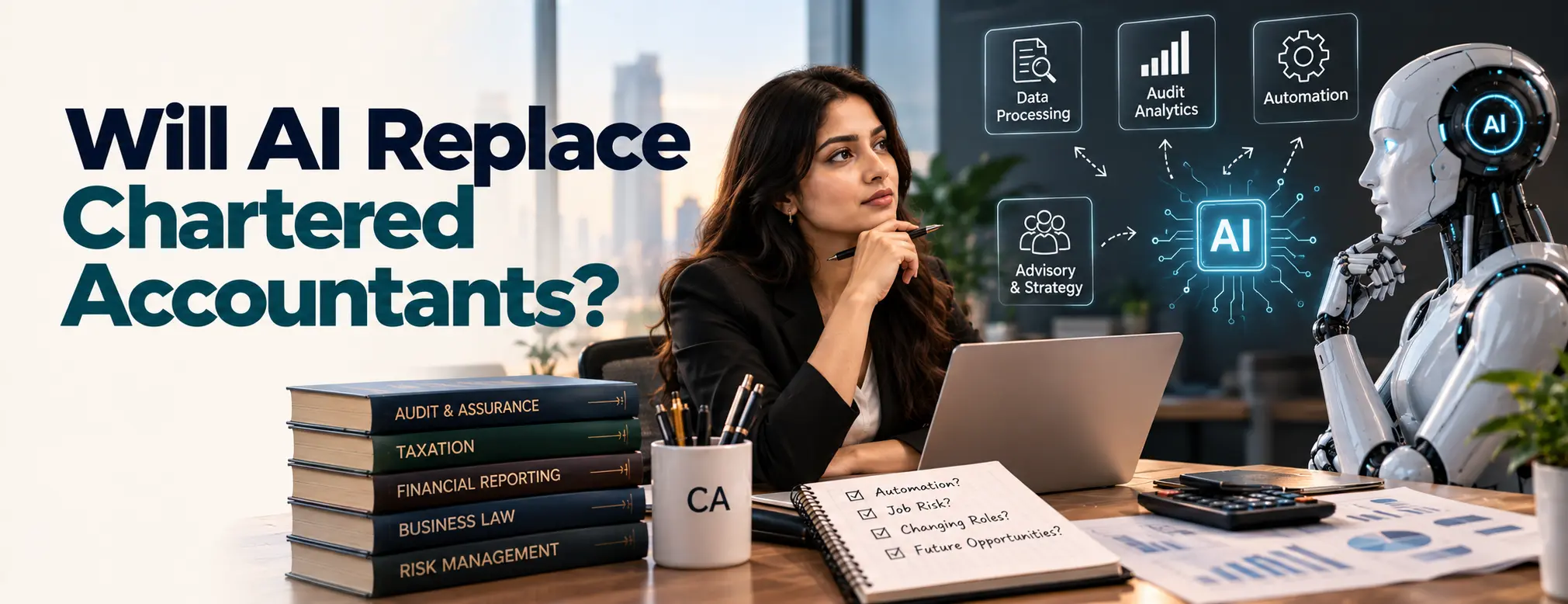
Will AI Replace Chartered Accountants? Future of CA in 2026
CA Archit Agarwal |
Wed, August 12, 2026
When studying CA or aspiring to become a chartered accountant, you might have asked yourself:
Will AI take the place of Chartered Accountants?
The short answer is, it's likely not the job that CAs do, but the job that CAs will do.
Some of the things where AI is already useful include document checks, analysing large volumes of data, identifying unusual transactions, research, and report preparation. With the appropriate tools, some of the tasks that used to take hours can be accomplished much faster.
So, then should CA students be concerned?
Not about a lack of career opportunities in the CA field. However, the method of CAs is likely to change.
In fact, this change has already taken place in India. ICAI has been proactively involved in AI for the profession.
But rather, "Will AI replace CAs?"
It is:
What are the tasks AI can take on in the CA field, and what will CAs need to do in the future?
How Is AI Changing the Work of Chartered Accountants?
What are the implications of AI for Chartered Accountants?
AI is already used as support for various types of financial work.
A particular example may be a CA having to review hundreds or thousands of transactions. Rather than having to make the effort of doing all of this manually, technology can help identify unusual entries or potential errors that require further investigation.
AI and automation can assist in other areas, including:
- Bookkeeping: Recording and categorising financial information.
- Invoice processing: Reading the invoice and extracting the details.
- Reconciliation: Finding differences between two sets of records
- Audit: Checking a significant amount of transaction data
- Tax research: Locating and summarising the information.
- Financial analysis: Trends and unusual changes in numbers
- Reporting: Summarising and drafting reports
- Compliance: Monitoring regular needs and mismatches
Now, ICAI's own AI platform features examples of the use of AI for GST reconciliation, audit, financial reporting, document analysis, and more related to the CA profession.
However, there's a significant point here.
AI can assist in the process. Is not responsible for the final solution.
Even though a CA has already reviewed the information, they should review it again to understand the situation and determine what needs to happen next.
Also Read This: Artificial Intelligence in Audit: How AI Is Transforming the Audit Process
Will AI Replace Chartered Accountants?
Should Chartered Accountants be replaced by AI?
AI could automate some of the functions of Chartered Accountants, but not the role of the Chartered Accountant.
Think about the work a CA does.
There are some repetitive tasks. They are step-by-step and utilize extensive amounts of data. These are more manageable for software/AI.
But other tasks in the job are much more difficult to automate.
For instance, a CA might have to:
- Know the context and purpose of a transaction
- Determine if an accounting treatment is appropriate
- Explain the meaning of a tax or accounting principle
- Investigate an unusual transaction
- Communicate a financial problem to a client
- Be aware of the dangers of a business decision
- Determine if evidence is present to support a conclusion
- Take responsibility for professional advice
AI can provide you with information.
It is up to the CA to determine the significance of that information.
That is why it is better to consider the possibility of collaboration between AI and CAs, instead of the question of which one will be replaced by the other.
AI vs Chartered Accountants: What Can AI Do?
One simple way to understand the change is to look at individual tasks.
| CA Work | How AI Can Help | What the CA Still Does |
|---|---|---|
| Data entry | Extract and organise data | Check the data |
| Invoice checking | Read and compare invoices | Review unusual cases |
| Reconciliation | Match records and find differences | Investigate mismatches |
| Audit testing | Check large amounts of data | Review findings and use professional judgment |
| Financial analysis | Find trends and unusual changes | Understand what the changes mean |
| Tax research | Find relevant information faster | Check the law and apply it correctly |
| Report writing | Prepare a first draft | Review and approve the report |
| Compliance | Track routine tasks | Handle difficult or unusual cases |
| Fraud checks | Find unusual patterns | Investigate the reason behind them |
This is why it is better to talk about tasks being automated instead of saying an entire profession will disappear.
Which CA Tasks Are Most Likely to Be Automated?
AI is generally better suited to work that is:
- Repetitive
- Based on clear rules
- Done in large volumes
- Based on structured data
- Time-consuming but predictable
Some examples are:
- Data entry
- Invoice processing
- Basic reconciliation
- Document checking
- Routine data analysis
- Standard report preparation
- Some compliance checks
- Parts of audit testing
But automation does not always mean that people disappear from the process.
A CA may simply move from doing every step manually to checking the work, finding exceptions, and making decisions.
The World Economic Forum's Future of Jobs Report 2025 lists accountants and auditors among roles facing structural change. The same report also identifies analytical thinking, AI and big data, and technological literacy as important skills for the future.
So the change is not as simple as:
AI replaces CA.
It is more like:
AI changes what the CA spends time doing.
Will AI Replace CA Jobs in India?
AI is unlikely to replace Chartered Accountants in India completely, but it will change the way many CA jobs are performed. Tasks such as bookkeeping, data entry, reconciliations, invoice processing, basic reporting and routine compliance can increasingly be automated with AI and other technologies.
However, CA work involves much more than processing financial data. Areas such as complex tax matters, audit judgment, financial due diligence, valuation, regulatory interpretation, risk assessment and client advisory still require professional expertise and human judgment.
The bigger change may be in the skills employers expect from CAs. Professionals who can combine accounting knowledge with AI tools, automation, data analysis and business understanding are likely to be better positioned for the changing workplace.
So, the question is not simply whether AI will replace CAs. AI is more likely to replace parts of a CA's job while increasing the value of CAs who can use technology effectively.
Will AI Replace CA Articleship and Fresher Jobs?
This is an important question for CA students.
Articles and freshers often work on tasks such as:
- Preparing working papers
- Entering data
- Checking documents
- Doing reconciliations
- Collecting information
- Preparing basic reports
- Performing routine audit work
- Doing research
- Handling recurring compliance work
Some of these tasks can be automated or completed faster with technology.
That may change what firms expect from junior professionals.
Instead of spending most of their time doing repetitive work, junior CAs and articles may increasingly need to know how to:
- Check AI-generated work
- Find errors
- Analyse financial data
- Use Excel and Power BI
- Use AI for research
- Understand automation
- Explain their findings
- Apply accounting knowledge to real business situations
So for a CA student, learning AI does not mean leaving accounting behind.
It means adding another useful skill to your accounting knowledge.
What Will Chartered Accountants Do in the Future?
Imagine an AI system that can:
- Collect transaction data
- Compare financial records
- Find unusual entries
- Read documents
- Prepare a first draft of a report
- Highlight possible risks
The CA can then spend more time asking questions such as:
- Why did this transaction happen?
- Is the accounting treatment correct?
- Why has this number changed so much?
- Is there a risk that we are missing?
- Does the evidence support this conclusion?
- What should the client do next?
These questions are not simply about finding numbers.
They require the person doing the work to understand the business and the situation.
That is why future CAs may spend less time on manual data work and more time on:
- Financial analysis
- Advisory
- Risk management
- Business decisions
- Audit investigation
- Technology-enabled finance
- Client communication
What Skills Will Chartered Accountants Need in the AI Era?
Knowing accounting, taxation, and audit will still be important.
But CAs will also need some new skills.
1. AI Skills
You do not need to become a software engineer.
You should understand what AI can do, what it cannot do, and how to use it properly.
2. Data Analysis
CAs will increasingly work with large amounts of data.
Skills in Excel, Power BI, and data analysis can help you understand that data better.
3. Technology Skills
Knowing how accounting software, ERP systems, automation tools, and AI tools work can make your work easier.
4. Professional Judgment
AI may give you an answer.
You still need to decide whether that answer makes sense.
5. Critical Thinking
Do not accept an AI answer just because it sounds confident.
Check the facts.
Look at the evidence.
Ask questions.
6. Communication
A CA must be able to explain financial information clearly to clients, managers, and business leaders.
7. Business Understanding
Numbers do not tell the whole story.
A CA who understands how a business works can give better advice.
8. Data Privacy
CAs work with sensitive financial and client information.
They need to understand what information can safely be used with AI tools and what should remain protected.
ICAI's AI platform also includes work around privacy, data management, and responsible AI use, showing that AI skills for CAs go beyond simply knowing how to use ChatGPT.
Can AI Make Chartered Accountants More Productive?
Yes.
Imagine a CA has to check thousands of transactions.
Instead of manually looking at every transaction, an AI-based system can help identify unusual items first.
The CA can then spend time checking those items.
The process becomes:
AI finds the unusual transaction → CA checks it → CA understands the reason → CA decides what to do.
That can save time without removing the CA from the process.
ICAI's AI use cases already show examples of this type of work, including GST reconciliation, financial analysis, audit support, and document analysis.
Can AI Make Mistakes in CA Work?
Yes. And this is one of the biggest reasons CAs cannot simply accept every AI answer.
AI can sometimes:
- Give incorrect information
- Misunderstand the question
- Miss important context
- Produce an answer that sounds correct but is not
- Use an incorrect or outdated source
- Make mistakes when handling complex information
ICAI's own AI use-case material includes discussions of problems such as hallucinated references and irrelevant answers when AI is used for tax and legal work.
This matters a lot in finance.
An incorrect answer in a casual conversation may be annoying.
An incorrect answer about tax, audit, or financial reporting can create a much bigger problem.
So CAs need to learn two things:
How to use AI.
And:
How to check AI.
Does AI Make a CA Career Less Valuable?
Not necessarily.
It may reduce the amount of time spent on some routine tasks.
But it can also give CAs more time for work that requires deeper thinking.
For example, if software handles basic reconciliation, a CA can spend more time understanding why the numbers do not match.
If AI finds unusual transactions during an audit, the CA can spend more time investigating them.
If AI helps with research, the CA can spend more time understanding how the information applies to the client.
So the value of a CA may increasingly come from what they do with the information, not simply how quickly they can process it.
Should You Still Become a CA With AI Growing So Fast?
If you are thinking about becoming a CA, AI is worth considering.
But AI does not make accounting, audit, taxation or finance knowledge useless.
A CA qualification still gives you a strong base in these areas.
The difference is that you may need to build more skills alongside it.
A useful combination for the future could be:
Accounting + AI + Data + Business + Communication
If you are comfortable learning new technology and solving business problems, you can use AI as a tool rather than seeing it only as competition.
But don't choose CA only because you think it is a completely "safe" career.
Choose it because you are interested in finance, accounting, business and the type of work CAs do.
Then keep adding new skills as the profession changes.
How Can CA Students Prepare for AI?
CA students do not need to become AI experts overnight. The better approach is to build practical skills that combine accounting knowledge, AI tools, data analysis, and business understanding.
Here are some skills that can help CA students prepare for an AI-driven finance career.
1. Learn the Basics of AI
Start by understanding what generative AI is, how tools such as ChatGPT work, what they can do, and where they can make mistakes.
You do not need to learn how to build AI models. Focus on understanding how AI can support everyday finance and accounting tasks.
2. Use AI for Practical Finance Tasks
Start experimenting with AI for tasks such as research, summarising financial information, explaining concepts, creating first drafts, and analysing basic data.
If you want to understand how AI can be applied specifically to finance, a practical AI for Finance course can help you learn through real finance use cases rather than just theory.
Always verify important information before using AI-generated output professionally.
3. Strengthen Your Excel Skills
Excel remains an important tool for finance professionals. Instead of treating AI as a replacement for Excel, learn how the two can work together.
Building skills from basic formulas to advanced functions, financial analysis, and automation can make Excel much more useful in day-to-day finance work.
Thinking Bridge's MS Excel Course covers Excel from basics to advanced skills, along with AI and automation, making it useful for both beginners and finance professionals.
4. Learn Power BI and Data Analysis
Finance professionals increasingly need to work with large amounts of data and present it in a way that supports business decisions.
Learning Power BI, data visualisation, and financial data analysis can help CA students move beyond preparing reports and become better at interpreting and communicating financial information.
5. Learn How to Write Better AI Prompts
Getting useful results from AI is not simply about asking a question. You need to provide the right context, explain the task clearly, and specify the type of output you need.
CA students should practise writing prompts for tasks such as financial analysis, research, Excel assistance and report preparation.
6. Learn to Verify AI-Generated Information
AI can produce confident but incorrect answers. This is especially important when dealing with tax provisions, accounting standards, case law, regulations and financial conclusions.
Do not use an AI-generated answer simply because it sounds correct. Check important information against the original law, regulation, standard or authoritative source.
7. Improve Your Communication Skills
AI may help process and explain financial information, but finance professionals still need to communicate their findings clearly.
The ability to explain numbers, present financial insights, and discuss recommendations with clients or management will remain valuable.
8. Keep Learning
AI tools and finance technology will continue to change. You do not need to learn every new tool that appears.
Instead, build the habit of learning, experimenting, and understanding how new technology can improve your work.
For CA students, the goal is not to compete with AI. It is to become a finance professional who knows how to use AI effectively while bringing the judgment, accountability, and business understanding that technology cannot replace.
AI Tools CA Students and Professionals Can Explore
You do not need to use every AI tool available.
Instead, learn what different types of tools can help you do.
- Generative AI tools: Useful for research, brainstorming, explanations, summaries, and first drafts.
- CA-focused AI tools: These are designed around accounting, audit, tax, and finance use cases.
- Excel and Power BI AI features: Useful for working with financial data and creating reports.
- Document AI: Can help extract information from invoices, statements, and other documents.
- Automation tools: Can reduce repetitive work in finance and accounting processes.
The goal is not to collect as many AI tools as possible.
The goal is to understand which tool can solve which problem.
Will AI Replace Accountants Before Chartered Accountants?
AI is more likely to automate routine accounting tasks before it replaces work that requires deeper professional judgment. For example, AI and accounting software can already help with data entry, invoice processing, bank reconciliation, transaction categorisation and basic financial reports.
A CA’s work often goes beyond recording transactions. It can involve auditing financial statements, assessing risks, reviewing complex transactions, interpreting tax rules, investigating unusual entries and advising a client or business on what to do next. These tasks require context, professional judgment and accountability.
This does not mean accountants are simply going to disappear while CAs remain unchanged. The real change will happen at the task level. An accountant who mainly handles repetitive data and bookkeeping work may see more automation, while an accountant who develops skills in analysis, reporting, technology and advisory work may take on more complex responsibilities.
The same applies to CAs. AI can automate parts of their work, but it cannot remove the need to review results, question unusual findings, and take responsibility for professional decisions.
So the better question is not “Will AI replace accountants before CAs?” It is “Which accounting and CA tasks can AI automate, and which still require professional judgment?”
FAQs
1. Will AI replace Chartered Accountants completely?
There is no current evidence that AI can independently perform the full range of work done by Chartered Accountants. AI can help with many repetitive and data-heavy tasks, but CAs still need to apply professional judgment, check information, communicate with clients and take responsibility for their work.
2. Will AI replace CA jobs in India?
AI is likely to change some CA tasks in India, especially repetitive and data-heavy work. At the same time, ICAI is actively helping CAs learn and use AI through initiatives such as its AI Certificate Course and CA GPT.
3. How will AI affect Chartered Accountants?
AI can reduce the time spent on repetitive work and increase the importance of data analysis, technology skills, professional judgment, advisory work, and communication.
4. Will AI replace CA articleship jobs?
Some repetitive tasks done during articleship may become automated. This means CA students may need to build stronger skills in data analysis, technology, AI, and professional judgment.
5. What is the future of Chartered Accountancy with AI?
The CA profession is likely to become more technology-driven. CAs may use AI for research, analysis, document work, reconciliation, and other tasks while spending more time on judgment, investigation, advisory work, and business decisions.
6. Should I still become a CA with AI growing so fast?
AI does not make the CA qualification irrelevant. However, CA students should consider learning AI, data analysis, technology, and communication skills alongside accounting, audit, and taxation.
7. What AI skills should CA students learn?
Start with AI basics, AI-assisted research, Excel, Power BI, data analysis, automation concepts, and the ability to check AI-generated information.
Conclusion
AI is unlikely to simply replace Chartered Accountants. Instead, it will change how they work. AI can handle tasks such as reading documents, analysing data, finding unusual transactions, and preparing first drafts, making routine work faster.
But CAs still need to ask: Is this correct? What does it mean? What is the risk? What should we do next? These decisions require professional knowledge, business understanding, and human judgment.
The CA profession in India is already moving in this direction, with ICAI introducing AI training and practical use cases across accounting, audit, GST and reporting.
For CA students and finance professionals, the future is not CA vs AI. It is about learning both. The future CA may be the person who knows what to automate, what to question, and where human judgment matters most.
About Author